
The overall budget deficit,
as a percentage of GDP at market prices, declined from 3.6 per cent in 1998-99
to 3.1 per cent in 1999-00. Total
derived revenue and grants increased by 9.5 per cent in 1999-00 compared to
15.3 per cent in 1998-99. Total derived
expenditure and lending minus repayments grew by 7.8 per cent in 1999-00 as
compared to a higher rise of 14.0 per cent in 1998-99. The deficit was financed exclusively from
domestic sources, namely commercial banks and the non-bank sector. Net financing of the deficit from the Bank
of Mauritius was negative. Total
central Government debt, as a percentage of GDP at market prices, remained
unchanged at 50.0 per cent at the end of June 2000 compared to end-June 1999.
Revenue
and Grants
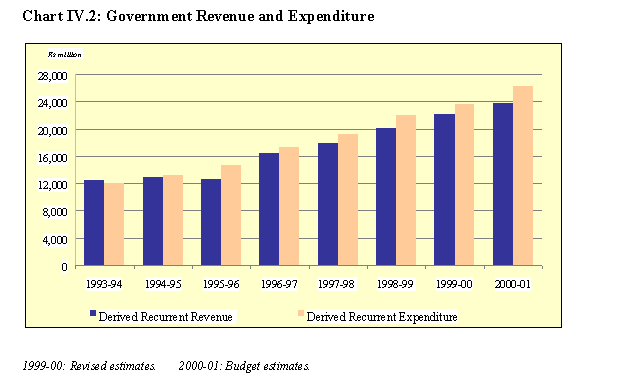
Total derived revenue excluding grants rose from Rs21,191 million in 1998-99 to Rs23,230 million in 1999-00, or by 9.6 per cent, compared to a higher increase of 15.9 per cent in the preceding year. The lower growth in total derived revenue excluding grants is partly attributable to a decline in non-tax revenue and marginally lower growth in tax revenue. Grants received by Government fell from Rs135 million in 1998-99 to Rs120 million in 1999-00. As a percentage of GDP at market prices, total derived revenue and grants decreased from 20.9 per cent in 1998-99 to 20.6 per cent in 1999-00.
Tax revenue rose by 13.5 per cent in 1999-00, from Rs17,872 million in 1998-99 to Rs20,279 million, slightly lower than the growth of 13.8 per cent in the preceding year. Tax revenue continued to grow at a higher rate than GDP at market prices in 1999-00, as indicated by a buoyancy of 1.2 in 1999-00 and 1.3 in 1998-99. The tax-to-GDP ratio maintained an upward trend in 1999-00, increasing from 17.5 per cent in 1998-99 to 17.8 per cent in 1999-00. Correspondingly, the share of tax revenue in total derived revenue excluding grants went up from 84.3 per cent in 1998-99 to 87.3 per cent during the year under review.
Direct
tax revenue went up by 5.2 per cent in 1999-00, from Rs4,023 million in 1998-99
to Rs4,231 million, compared to a higher rise of 11.4 per cent in the previous
year. The buoyancy of direct tax
revenue with respect to GDP at market prices fell to 0.5 in 1999-00 from 1.1 in
1998-99. The share of direct tax in tax
revenue continued on its downward trend, declining from 22.5 per cent in
1998-99 to 20.9 per cent in 1999-00.
Revenue
from income tax, consisting of individual income taxes and corporate tax, rose
from Rs2,700 million in 1998-99 to Rs2,865 million in 1999-00, or by 6.1 per
cent, lower than the growth of 12.1 per cent in 1998-99. Income tax from individuals amounted to
Rs1,520 million, that is, a rise of 11.5 per cent compared to 10.1 per cent in
the previous year. Corporate tax
amounted to Rs1,345 million during the year under review, representing an
increase of 0.6 per cent compared to 14.2 per cent in 1998-99.
Indirect taxes continued to be dominated by domestic taxes on goods and services. Revenue from indirect taxes increased from Rs13,848 million in 1998-99 to Rs16,048 million in 1999-00, or by 15.9 per cent, compared to a rise of 14.5 per cent in the preceding year. The share of indirect taxes in total tax revenue maintained an upward trend, increasing from 77.5 per cent in 1998-99 to 79.1 per cent in 1999-00. Indirect taxes continued to grow faster than GDP at market prices as shown by the buoyancy of indirect tax revenue of 1.3 in 1998-99 and 1.4 in 1999-00.
The share of domestic taxes on goods and services in total indirect tax continued to rise in 1999-00. Domestic taxes on goods and services, comprising mainly excises, sales tax/value-added tax, taxes on transportation, taxes on gambling and taxes on hotels and restaurants, contributed a higher share of 57.5 per cent in tax revenue in 1999-00 compared to 48.6 per cent in 1998-99. This was mainly due to the large increase in excises. Revenue from sales tax/value-added tax increased from Rs4,639 million in 1998-99 to Rs5,598 million in 1999-00, or by 20.7 per cent, compared to an increase of 70.2 per cent in the preceding year as a result of the introduction of VAT in September 1998. The share of sales tax/value-added tax in tax revenue went up from 25.9 per cent in 1998-99 to 27.6 per cent in the year under review.
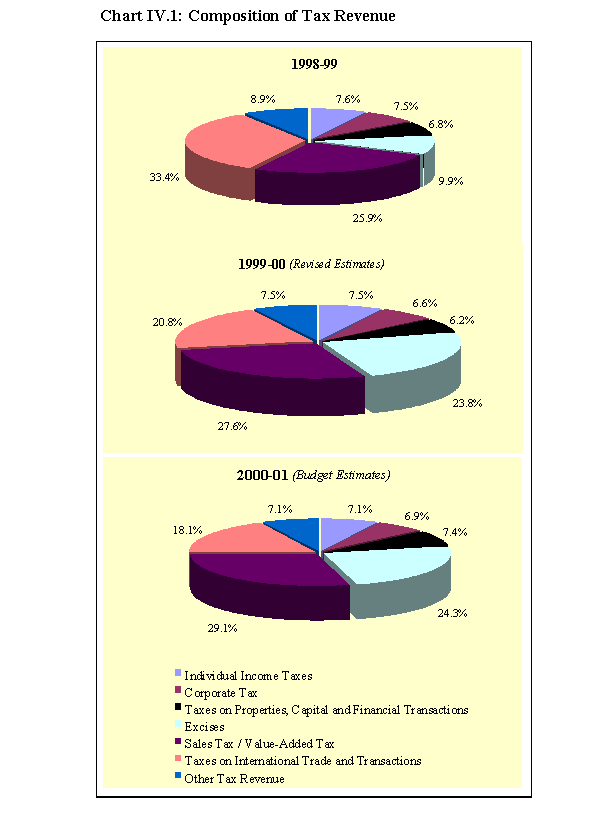
Revenue
from excises on local manufactures and on imports rose from Rs2,686 million in
1998-99 to Rs4,837 million in 1999-00.
As a percentage of tax revenue, excises increased from 15.0 per cent in
1998-99 to 23.8 per cent in 1999-00.
Taxes on international trade and transactions, comprising almost exclusively of import and customs duties, declined from Rs5,063 million in 1998-99 to Rs4,211 million in 1999-00, or by 16.8 per cent, compared to a fall of 2.5 per cent in the preceding year. The share of taxes on international trade and transactions in tax revenue maintained a declining trend, falling from 28.3 per cent in 1998-99 to 20.8 per cent in 1999-00.
Non-tax revenue, which consists mainly of receipts from public services, interest, royalties and other property income, dropped from Rs2,224 million in 1998-99 to Rs1,921 million in 1999-00. The share of non-tax revenue in total derived revenue exclusive of grants fell from 10.5 per cent in 1998-99 to 8.3 per cent in 1999-00.
Derived
capital revenue, mainly in the form of dividends from investments and disposal
of assets, declined marginally from Rs1,096 million in 1998-99 to Rs1,031
million in 1999-00.
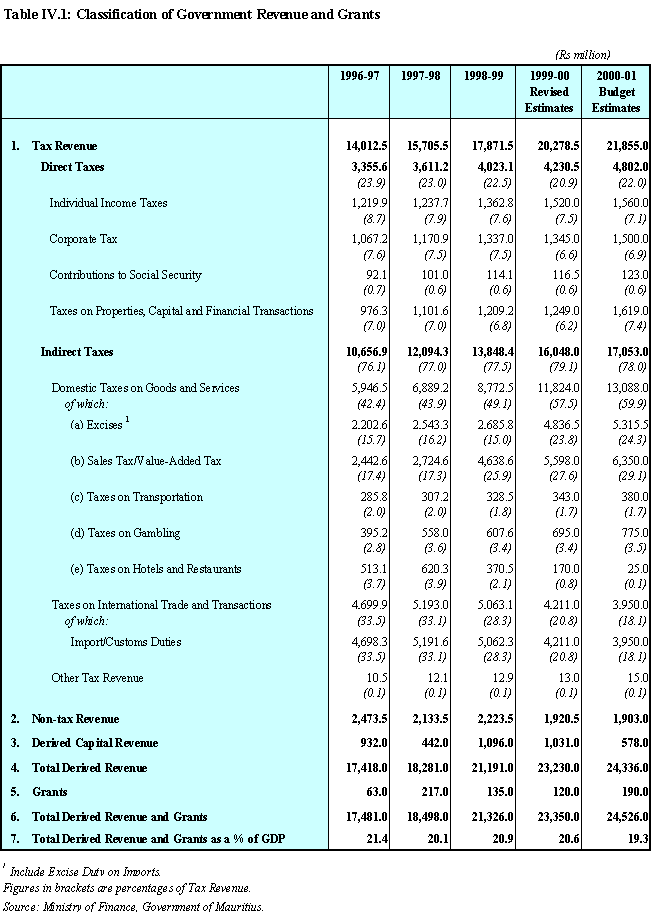
Table IV.1 gives details on
Government revenue and grants between 1996-97 and 2000-01. Charts IV.1 and IV.2 show the composition of
tax revenue for the years 1998-99 through 2000-01 and Government revenue and
expenditure for the years 1993-94 through 2000-01, respectively.
Expenditure
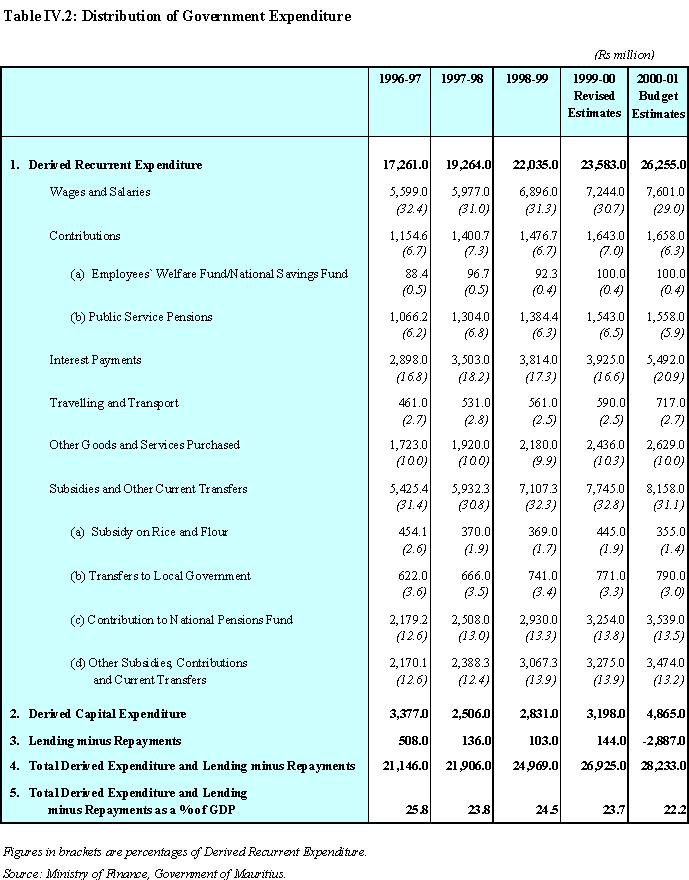
Total derived expenditure and lending minus repayments increased by 7.8 per cent in 1999-00, from Rs24,969 million in 1998-99 to Rs26,925 million in 1999-00, lower than the increase of 14.0 per cent in the preceding year. Relatively lower growth in the main items of recurrent expenditure, namely wages and salaries, interest payments, and subsidies and other current transfers, are primarily responsible for the lower rise in total derived expenditure and net lending. As a percentage of GDP at market prices, total derived expenditure and lending minus repayments fell from 24.5 per cent in 1998-99 to 23.7 per cent in 1999-00.
Derived recurrent expenditure increased by 7.0 per cent, from Rs22,035 million in 1998-99 to Rs23,583 million in 1999-00, lower than the increase of 14.4 per cent in the preceding year. Wages and salaries continued to be the largest single item of derived recurrent expenditure in 1999-00, although the share of expenditure on this item in derived recurrent expenditure fell from 31.3 per cent in 1998-99 to 30.7 per cent in 1999-00. Expenditure on wages and salaries went up by 5.0 per cent in 1999-00, from Rs6,896 million in 1998-99 to Rs7,244 million in 1999-00, compared to a higher rise of 15.4 per cent in the preceding year.
Expenditure
on subsidies and other current transfers rose from Rs7,107 million in 1998-99
to Rs7,745 million in 1999-00, or by 9.0 per cent, compared to a rise of 19.8
per cent in the preceding year. The
share of expenditure on subsidies and other current transfers in derived
recurrent expenditure increased from 32.3 per cent in 1998-99 to 32.8 per cent
in the year under review.
Interest payments rose by 2.9 per cent in 1999-00, from Rs3,814 million in 1998-99 to Rs3,925 million, compared to a higher increase of 8.9 per cent in the preceding year. As a percentage of derived recurrent expenditure, interest payments fell from 17.3 per cent in 1998-99 to 16.6 per cent in 1999-00.
Derived
capital expenditure rose from Rs2,831 million in 1998-99 to Rs3,198 million in
1999-00, or by 13.0 per cent, similar to the increase in the preceding year.
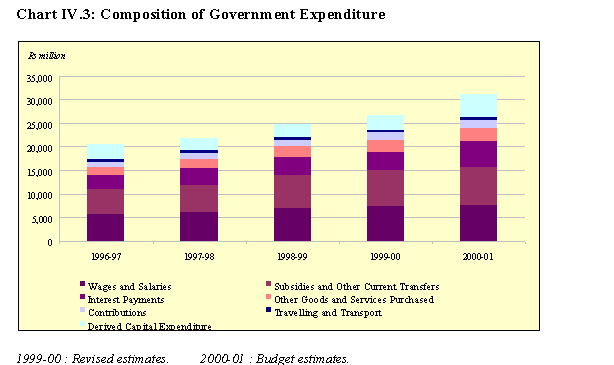
The distribution of
Government expenditure for the period 1996-97 through 2000-01 is given in Table
IV.2. Chart IV.3 depicts the
composition of Government expenditure for the years 1996-97 through 2000-01.
Budgetary Operations and Financing
of the Deficit
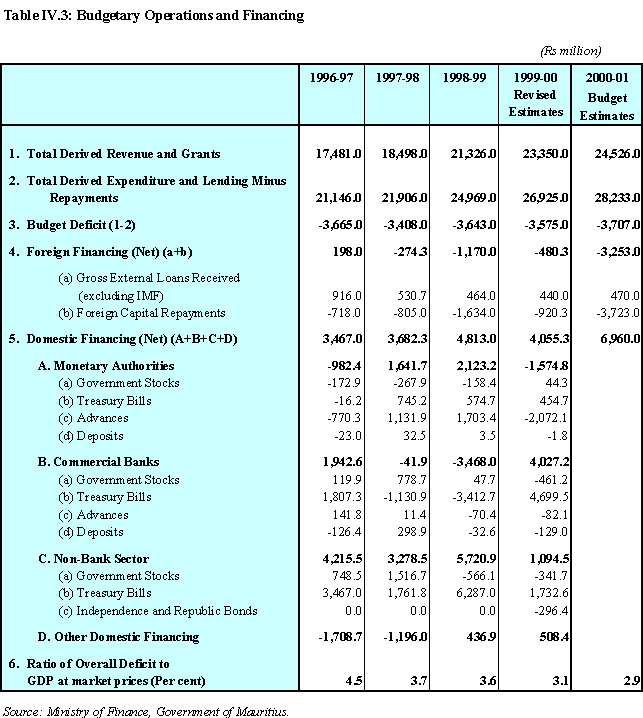
The overall budget deficit
amounted to Rs3,575 million in 1999-00, which represented 3.1 per cent of GDP
at market prices. The deficit continued
to be financed exclusively from domestic sources in 1999-00. Net foreign financing of the budget deficit
was negative at Rs480 million in 1999-00, with borrowings from abroad amounting
to Rs440 million and repayment of loans totalling Rs920 million.
Net domestic financing of
the deficit amounted to Rs4,055 million in 1999-00. Commercial banks were the major source of domestic financing,
providing a net amount of Rs4,027 million while the non-bank sector financed an
amount of Rs1,095 million. In
contrast, deficit financing by the Bank of Mauritius was negative at Rs1,575
million.
Table IV.3 shows the financing of the
budget deficit by type of debt holder and instrument for the period 1996-97
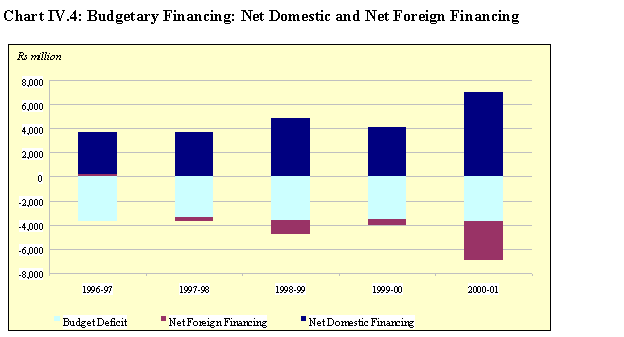
through 2000-01. Chart IV.4 depicts net
domestic and net foreign financing for the fiscal years 1996-97 through
2000-01.
Internal Debt
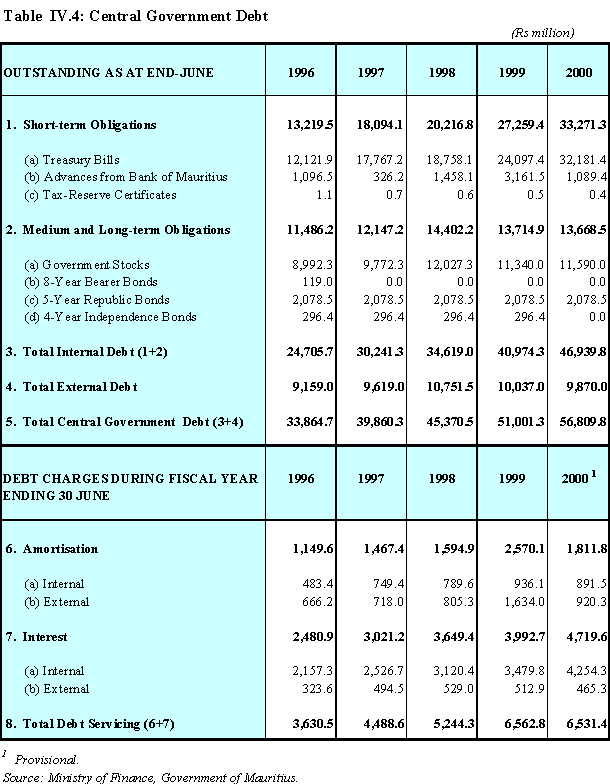
Total internal debt of Government increased by 14.6 per cent in 1999-00, from Rs40,974 million at the end of June 1999 to Rs46,940 million at the end of June 2000. The rise in short-term obligations of the Government largely accounted for the increase in internal debt. As a percentage of GDP at market prices, total internal debt rose from 40.2 per cent at the end of June 1999 to 41.3 per cent at the end of June 2000.
Short-term obligations of the Government went up by 22.1 per cent, from Rs27,259 million at the end of June 1999 to Rs33,271 million at the end of June 2000. Treasury Bills accounted for 96.7 per cent of short-term debt at the end of June 2000 compared to 88.4 per cent at the end of June 1999. Holdings of Treasury Bills by the non-bank sector as a percentage of total outstanding Treasury Bills fell from 57.8 per cent at the end of June 1999 to 50.2 per cent at the end of June 2000. The level of short-term obligations relative to total internal debt increased from 66.5 per cent at the end of June 1999 to 70.9 per cent at the end of June 2000.
Medium and long-term obligations of the Government fell by 0.3 per cent to Rs13,669 million at the end of June 2000. During the year under review, the redemption of long and medium-term Government securities amounting to Rs1,046 million, including the redemption of the 4-year Independence Bonds valued at Rs296 million, was partly offset by the issue of Mauritius Development Loan Stocks of Rs1,000 million.
The
non-bank sector continued to be the major holder of medium and long-term
obligations although the share of internal debt held by the non-bank sector
declined from 70.6 per cent at the end of June 1999 to 65.3 per cent at the end
of June 2000. As a proportion of total internal debt, medium and long-term
obligations of the Government declined from 33.5 per cent at the end of June
1999 to 29.2 per cent at the end of June 2000.
.
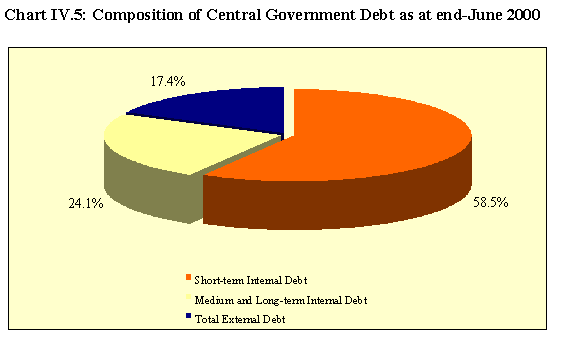
Table IV.4 gives details on central Government debt from end-June 1996 to end-June 2000. Chart IV.5 shows the composition of central Government debt as at end-June 2000
External
Debt
Total central Government external debt fell from Rs10,037 million at the end of June 1999 to Rs9,870 million at the end of June 2000. During the year ended June 2000, external loan disbursements amounted to Rs440 million. Debt repayments totalled Rs920 million while interest payments amounted to Rs465 million during the same period.
The level of external debt of parastatal bodies fell by Rs75 million to Rs16,826 million at the end of June 2000. For the year ended June 2000, loan disbursements to parastatal bodies amounted to Rs1,650 million. Capital repayments totalled Rs2,630 million in 1999-00 and interest payments amounted to Rs745 million over the same period.
The level of private sector external debt decreased by 2.7 per cent to Rs3,422 million at the end of June 2000. External borrowings of the private sector amounted to Rs23 million in 1999-00, lower than the amount of Rs39 million in the preceding year. Principal repayments amounted to Rs256 million and interest payments to Rs9 million for the period under review.
The debt service ratio of the country, that is principal and interest payments as a percentage of exports of goods and non-factor services, decreased from 7.6 per cent in 1998-99 to 7.2 per cent in 1999-00.