
Year 2000 Problem
No major problems were encountered at the Bank regarding the Year 2000 problem. The Bank had, as far back as 1997, initiated its Y2K project to review its computer system. Most of the essential components of the Bank's computer system, namely servers, the General Ledger system (Bankmaster), the Oracle RDBMS and the Oracle systems had to be upgraded since they were non-compliant. This phase of the project lasted till mid-1999. Towards the third quarter of 1999, a Contingency Plan was established to cater for any unforeseen events particularly from a financial point of view, namely the need for increased liquidity and additional demand for banknotes. Other arrangements had also been made to cater for any hardware/software failures, which could affect the normal operations of the Bank. All departments of the Bank had put in place alternative procedures for carrying out business in case of computer system failure due to the millennium date change. The Bank had also been monitoring the readiness of the commercial banks through monthly returns to ensure that the Year 2000 problem would not emerge as a major source of risk to the banking sector.
Mauritius Automated Clearing and Settlement System (MACSS)
The decision to reform the payments system of Mauritius goes as far back as 1993. The reform was considered essential in order to raise the efficiency of the payment system to cope with the development of the financial system of Mauritius. However, the project was stalled for some time. In September 1999, it was revived by the Governor of the Bank. Work is ongoing for implementation by mid-December 2000 of a Real Time Gross Settlement System (RTGS), known as The Mauritius Automated Clearing and Settlement System (MACSS).
To implement that project, a Steering Committee headed by the Managing Director has been working in close cooperation with commercial banks and the Ministry of Finance. There is the general feeling that the current MACSS project is firmly established and will be successful. The project that will lead to its implementation has now gathered momentum and the system will be live by mid-December 2000. All commercial banks will then be connected to the Bank of Mauritius via a computer network which will be used to exchange high-value payments in real time, that is, almost instantaneously. Other indirect beneficiaries of this system are the Central Depository and Settlement Co. Ltd, the Port-Louis Clearing House and customers of banks desirous of expediting time-sensitive transactions.
A rigorous selection exercise based on World Bank international bidding process standards had, earlier this year, designated Montran Corporation (USA), among five international bidders, as the successful bidder for providing software consultancy services for the RTGS. Montran Corporation (USA) is associating itself with PriceWaterhouseCoopers for the consultancy leg of the project.
The solution proposed by Montran is based on S.W.I.F.T. as the message carrier for the RTGS, in keeping with a decision to this effect taken by all commercial banks. The choice of S.W.I.F.T. has been favoured by two considerations: first, it is a proven secure network, which will be used as message carrier. Second, S.W.I.F.T. is commonly used by commercial banks in their normal operations. They therefore know the technology and usage, and the adaptation and learning curve will, hopefully, be very short.
The RTGS software has been developed using state-of-the-art technology. Java language has been used for the development of the RTGS server and Relational database technology is used for data storage. Web stations will be used on the participant banks' side for queue management and consultation of account balances. This will provide a valuable cash management tool for commercial banks and the Ministry of Finance.
MACSS
Architecture
The figure below shows the architecture of the MACSS. The Participant CBT (computer based terminal), which is basically a S.W.I.F.T. workstation, is used exclusively for issuing payment instructions. Payment instructions can also originate from other systems at the participant bank, like trading systems or systems processing standing orders. The payment instructions can then be batch processed in the Participant CBT. The payment instruction is then sent via the S.W.I.F.T. network. The RTGS Server receives the payment instruction via the S.W.I.F.T. CBT and processes it accordingly by debiting the paying bank's account and crediting the receiving bank's account, which are found on the General Ledger system at the Central Bank. The payment instruction is then forwarded to the receiving bank's CBT via the S.W.I.F.T. network. The Webstation provides the interface for the other functions of the system. A normal Internet browser on the Webstation is used for the consultation/reprioritisation of payment instructions and for sending/receiving secure email. Reporting is also available on the Webstation through the same channel.
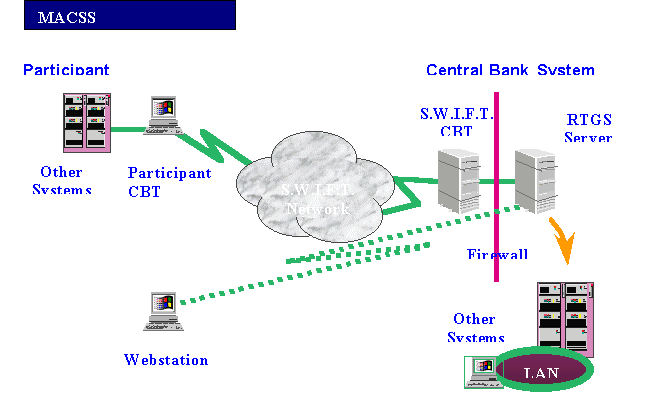
The features available to participants are:
. Submit payment instructions, which will have immediate finality, if funds are available;
. Queuing of payment instruction, in case of insufficient funds;
. Consultation/reprioritisation of queued payment instructions;
. Secured Email communication.
Training will be provided to all participants and to the Bank's staff responsible for maintenance of the system. The system will be owned by the Bank and investment cost of the main and fallback sites will be borne by the Bank. Operating cost will be imputed to the participants.
The system is due to start operating by 15 December 2000.