The overall budget deficit, as a percentage of GDP at market prices, declined from 3.7 per cent in 1997-98 to 3.6 per cent in 1998-99. The process of fiscal adjustment, which has been set in a medium-term framework, is well under way with the replacement of the sales tax by the value-added tax in September 1998 and the improved buoyancy of tax revenue. Total derived revenue and grants increased by 14.5 per cent in 1998-99 as compared to 5.8 per cent in 1997-98. Government efforts to curtail the growth of expenditure were partly mitigated by the salary increases stemming from the implementation of the public sector pay award. Total derived expenditure and lending minus repayments grew by 13.3 per cent in 1998-99 as compared to a lower rise of 3.6 per cent in 1997-98. The deficit was financed exclusively from domestic sources, namely the non-bank sector and the Bank of Mauritius. Net financing of the deficit from commercial banks and from abroad was negative. Total central Government debt, as a percentage of GDP at market prices, went up from 49.6 per cent at the end of June 1998 to 50.3 per cent at the end of June 1999.
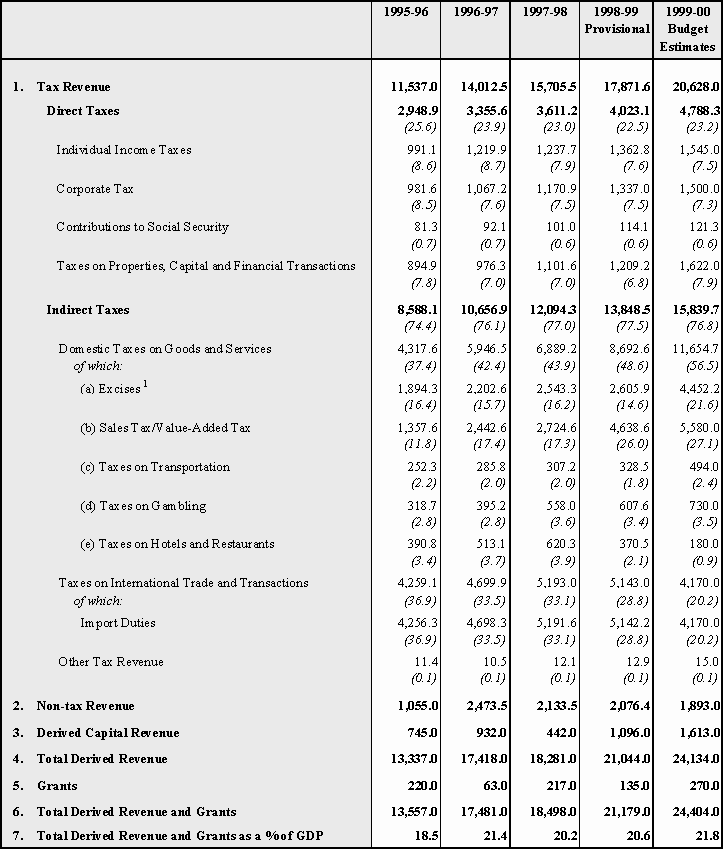
Total derived revenue excluding grants rose from Rs18,281 million in 1997-98 to Rs21,044 million in 1998-99, or by 15.1 per cent as compared to a lower increase of 5.0 per cent in the preceding year. Higher growth in both tax revenue and capital revenue accounted for the larger rise in total derived revenue in 1998-99. In contrast, grants received by Government declined from Rs217 million in 1997-98 to Rs135 million in 1998-99. As a percentage of GDP at market prices, total derived revenue and grants increased from 20.2 per cent in 1997-98 to 20.6 per cent in 1998-99.
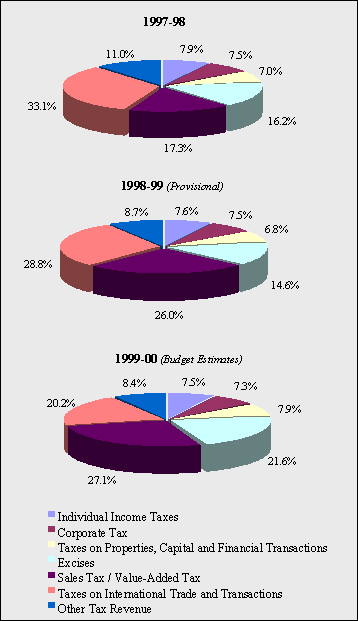
Tax revenue rose by 13.8 per cent in 1998-99, from Rs15,706 million in 1997-98 to Rs17,872 million, higher than the growth of 12.1 per cent in the preceding year. The replacement of the sales tax by the value-added tax in September 1998 coupled with improved buoyancy of both direct and indirect tax revenue led to the higher growth in tax revenue. The buoyancy of tax revenue with respect to GDP at market prices was 1.3 in 1998-99 as compared to 1.0 in 1997-98, indicating a higher growth of tax revenue relative to that of GDP. However, the share of tax revenue in total derived revenue excluding grants fell from 85.9 per cent in 1997-98 to 84.9 per cent in the year under review.
Direct tax revenue went up by 11.4 per cent in 1998-99, from Rs3,611 million in 1997-98 to Rs4,023 million, as compared to a lower rise of 7.6 per cent in the previous year. The buoyancy of direct tax revenue with respect to GDP at market prices was 1.1 in 1998-99 as against 0.6 in 1997-98. The share of direct taxes in tax revenue maintained a downward trend, falling from 23.0 per cent in 1997-98 to 22.5 per cent in 1998-99.
Revenue from income tax, comprising individual income taxes and corporate tax, rose from Rs2,409 million in 1997-98 to Rs2,700 million in 1998-99 or by 12.1 per cent, higher than the growth of 5.3 per cent in 1997-98. Income tax from individuals contributed an amount of Rs1,363 million while corporate tax accounted for Rs1,337 million in 1998-99, increasing by 10.1 per cent and 14.2 per cent, respectively. They increased at lower rates of 1.5 per cent and 9.7 per cent, respectively, in the previous fiscal year.
Chart IV.1: Composition of Tax Revenue
Indirect taxes were dominated by domestic taxes on goods and services, which were the main source of the rise in indirect tax revenue in 1998-99. Revenue from indirect taxes increased from Rs12,094 million in 1997-98 to Rs13,849 million in 1998-99, or by 14.5 per cent as compared to a rise of 13.5 per cent in the preceding year. The share of indirect taxes in tax revenue maintained an upward trend, increasing from 77.0 per cent in 1997-98 to 77.5 per cent in 1998-99. The buoyancy of indirect tax revenue with respect to GDP at market prices was 1.4 in 1998-99 as compared to 1.1 in 1997-98.
Domestic taxes on goods and services, comprising mainly excises, sales tax/value-added tax, taxes on transportation, taxes on gambling and taxes on hotels and restaurants, contributed a higher share of 48.6 per cent in tax revenue in 1998-99 as compared to 43.9 per cent in 1997-98. This is mainly attributable to the replacement of the sales tax of 8 per cent by a value-added tax of 10 per cent with a broader base in September 1998. Revenue from sales tax/value-added tax increased from Rs2,725 million in 1997-98 to Rs4,639 million in 1998-99, or by 70.2 per cent as compared to an increase of 11.5 per cent in the preceding year. As a result, the share of sales tax/value-added tax in tax revenue went up from 17.3 per cent in 1997-98 to 26.0 per cent in the year under review.
Revenue from excises, which comprise excises on local manufactures and on imports, rose from Rs2,543 million in 1997-98 to Rs2,606 million in 1998-99, or by 2.5 per cent as compared to an increase of 15.5 per cent in 1997-98. As a percentage of tax revenue, excises declined from 16.2 per cent in 1997-98 to 14.6 per cent in 1998-99.
Taxes on international trade and transactions, which consist almost exclusively of import duties, declined from Rs5,193 million in 1997-98 to Rs5,143 million in 1998-99, or by 1.0 per cent as against a rise of 10.5 per cent in the preceding year. The share of taxes on international trade and transactions in tax revenue continued to decline, from 33.1 per cent in 1997-98 to 28.8 per cent in 1998-99, reflecting the lowering of tariffs in line with world trade liberalisation.
Non-tax revenue, which consists mainly of receipts from public services, interest, royalties and other property income, dropped from Rs2,134 million in 1997-98 to Rs2,076 million in 1998-99. Consequently, the share of non-tax revenue in total derived revenue exclusive of grants fell from 11.7 per cent in 1997-98 to 9.9 per cent in 1998-99.
Derived capital revenue, mainly in the form of dividends from investments and disposal of assets, rose from Rs442 million in 1997-98 to Rs1,096 million in 1998-99.
Table IV.1 gives details on Government revenue and grants between 1995-96 and 1999-00. Charts IV.1 and IV.2 show the composition of tax revenue for the years 1997-98 through 1999-00 and Government revenue and expenditure for the years 1992-93 through 1999-00, respectively.
Chart IV.2: Government Revenue and Expenditure
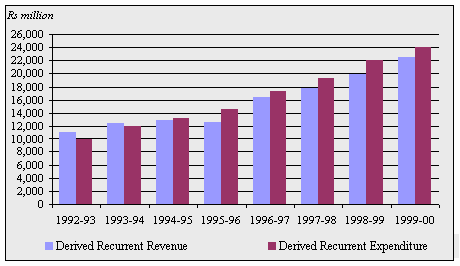
1998-99: Provisional. 1999-00: Budget estimates.
Table IV.1: Classification of Government Revenue and Grants
(Rs million)
1
Include Excise Duty on Imports.Figures in brackets are percentages of Tax Revenue.
Source: Ministry of Finance, Government of Mauritius.
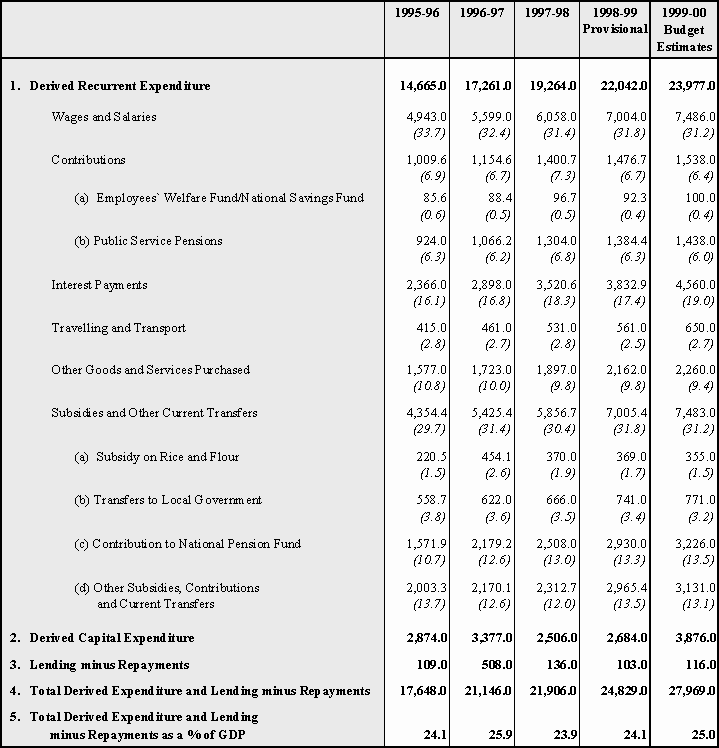
Total derived expenditure and lending minus repayments increased by 13.3 per cent in 1998-99, from Rs21,906 million in 1997-98 to Rs24,829 million in 1998-99, far higher than the increase of 3.6 per cent in the preceding year. Government efforts to curtail the growth of expenditure were mitigated by the large increase in salary stemming from the implementation of the public sector pay award during the year under review. As a percentage of GDP at market prices, total derived expenditure and lending minus repayments rose from 23.9 per cent in 1997-98 to 24.1 per cent in 1998-99.
Derived recurrent expenditure went up by 14.4 per cent, from Rs19,264 million in 1997-98 to Rs22,042 million in 1998-99 as compared to an increase of 11.6 per cent in the preceding year. Wages and salaries remained the largest single item of derived recurrent expenditure in 1998-99. Expenditure on this item increased by 15.6 per cent in 1998-99 following the rise in salaries in the public sector, from Rs6,058 million in 1997-98 to Rs7,004 million in 1998-99, as compared to a lower rise of 8.2 per cent in the preceding year. As a percentage of derived recurrent expenditure, wages and salaries went up from 31.4 per cent in 1997-98 to 31.8 per cent in 1998-99.
The share of expenditure on subsidies and other current transfers in derived recurrent expenditure increased from 30.4 per cent in 1997-98 to 31.8 per cent in the year under review. Expenditure on subsidies and other current transfers rose from Rs5,857 million in 1997-98 to Rs7,005 million in 1998-99, or by 19.6 per cent as compared to a rise of 7.9 per cent in the preceding year.
Interest payments rose at a lower rate of 8.9 per cent in 1998-99, from Rs3,521 million in 1997-98 to Rs3,833 million, as compared to a rise of 21.5 per cent in the preceding year. The share of interest payments in derived recurrent expenditure fell from 18.3 per cent in 1997-98 to 17.4 per cent in 1998-99.
Derived capital expenditure rose from Rs2,506 million in 1997-98 to Rs2,684 million in 1998-99, or by 7.1 per cent after falling by 25.8 per cent in the preceding year.
The distribution of Government expenditure for the period 1995-96 through 1999-00 is given in Table IV.2. Chart IV.3 depicts the composition of Government expenditure for the years 1995-96 through 1999-00.
Chart IV.3: Composition of Government Expenditure
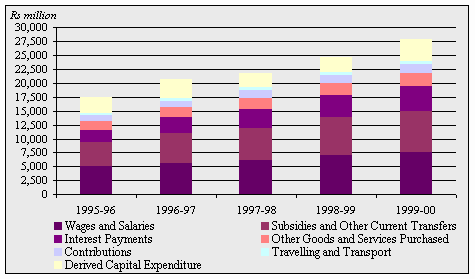
1998-99: Provisional. 1999-00: Budget estimates.
Table IV.2: Distribution of Government Expenditure
(Rs million)
Figures in brackets are percentages of Derived Recurrent Expenditure.
Source: Ministry of Finance, Government of Mauritius.
Budgetary Operations and Financing of the Deficit
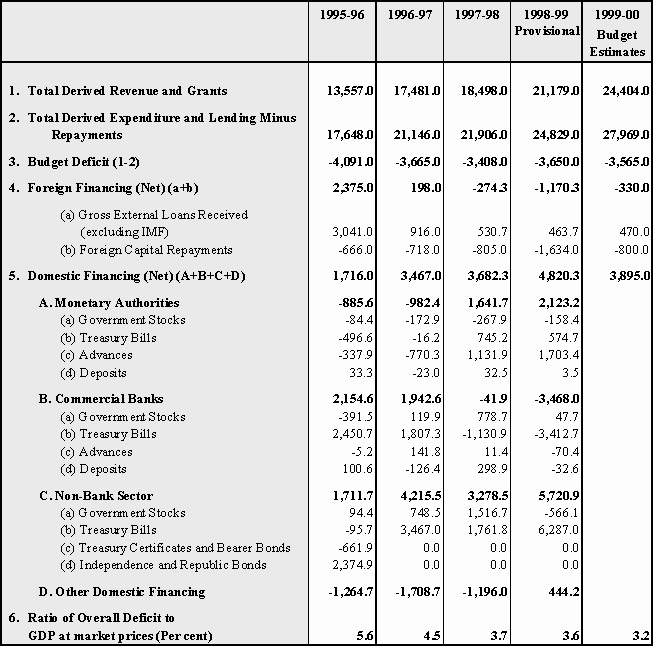
The overall budget deficit amounted to Rs3,650 million in 1998-99, which represented 3.6 per cent of GDP at market prices. The deficit was financed exclusively from domestic sources as in the preceding year. Net foreign financing of the budget deficit was negative at Rs1,170 million in 1998-99, with borrowings from abroad amounting to Rs464 million and repayments of loans, inclusive of the partial redemption of the Floating Rate Note (FRN) for an amount of Rs808 million (US$33 million), totalling Rs1,634 million.
Net domestic financing of the deficit amounted to Rs4,820 million. The non-bank sector was the major source of domestic financing and provided a net amount of Rs5,721 million. The Bank of Mauritius also financed a large share of the budget deficit with an amount of Rs2,123 million, of which advances accounted for Rs1,703 million. In contrast, deficit financing by commercial banks was negative at Rs3,468 million.
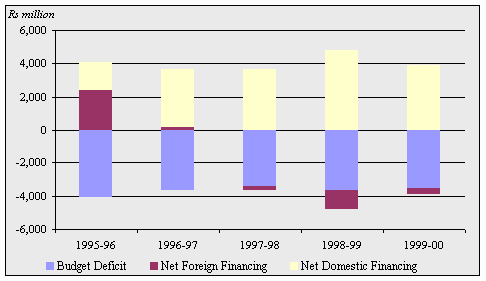
Table IV.3 shows the financing of the budget deficit by type of debt holder and instrument for the period 1995-96 through 1999-00. Chart IV.4 depicts net domestic and net foreign financing for the fiscal years 1995-96 through 1999-00.
Table IV.3 Budgetary Operations and Financing
(Rs Million)
Source: Ministry of Finance, Government of Mauritius.
Chart IV.4: Budgetary Financing: Net Domestic and Net Foreign Financing
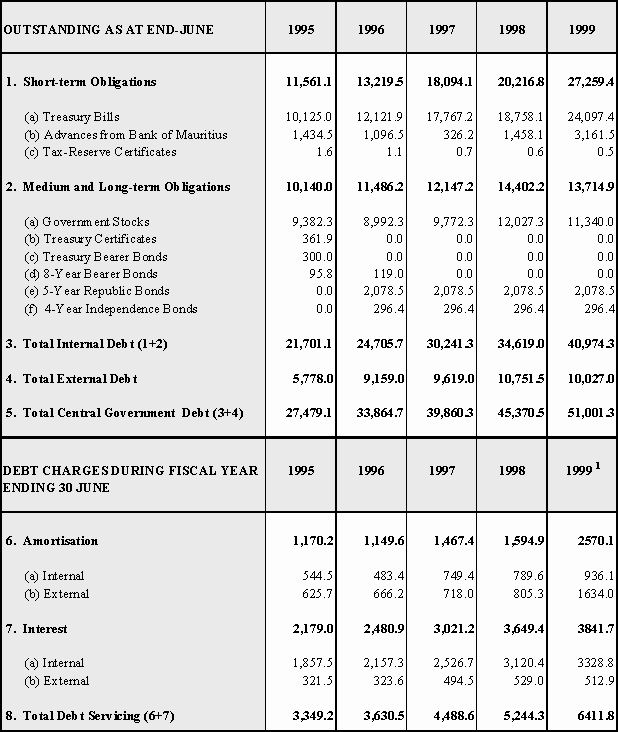
Total internal debt of the Government increased by 18.4 per cent, from Rs34,619 million at the end of June 1998 to Rs40,974 million at the end of June 1999. As a percentage of GDP at market prices, total internal debt rose from 37.8 per cent at the end of June 1998 to 40.4 per cent at the end of June 1999.
Government short-term obligations went up by 34.8 per cent from Rs20,217 million at the end of June 1998 to Rs27,259 million at the end of June 1999. Treasury Bills accounted for 88.4 per cent of short-term debt at the end of June 1999 as compared to 92.8 per cent at the end of June 1998. Holdings of Treasury Bills by the non-bank sector, as a percentage of total outstanding Treasury Bills, rose from 31.8 per cent at the end of June 1998 to 57.8 per cent at the end of June 1999. The level of short-term obligations relative to total internal debt rose from 58.4 per cent at the end of June 1998 to 66.5 per cent at the end of June 1999.
Medium and long-term obligations declined by 4.8 per cent to Rs13,715 million at the end of June 1999. Non-bank holdings of medium and long-term obligations fell from 71.2 per cent at the end of June 1998 to 70.6 per cent at the end of June 1999.
The share of medium and long-term obligations in total internal debt dropped from 41.6 per cent at the end of June 1998 to 33.5 per cent at the end of June 1999.
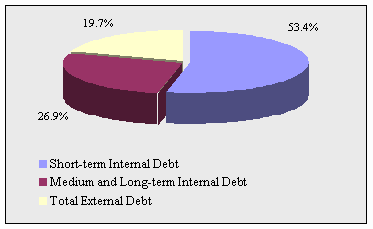
Table IV.4 gives details on central Government debt from end-June 1995 to end-June 1999. Chart IV.5 shows the composition of central Government debt as at end-June 1999.
Total central Government external debt fell from Rs10,752 million at the end of June 1998 to Rs10,027 million at the end of June 1999. During the year ended June 1999, external loan disbursements amounted to Rs464 million. Debt repayments, including the partial redemption of the FRN amounting to Rs808 million, totalled Rs1,634 million while interest payments amounted to Rs513 million during the same period.
The level of external debt of parastatal bodies went up by Rs1,876 million and reached Rs16,873 million at the end of June 1999. For the year ended June 1999, loan disbursements to parastatal bodies amounted to Rs2,854 million. Total capital repayments totalled Rs1,500 million in 1998-99 and interest payments amounted to Rs813 million over the same period.
The level of private sector external debt decreased by 10.9 per cent to Rs3,516 million at the end of June 1999. External borrowings of the private sector amounted to Rs39 million in 1998-99, lower than the amount of Rs160 million in the preceding year. Principal repayments amounted to Rs469 million and interest payments to Rs36 million for the period under review.
The debt service ratio of the country, that is, principal and interest payments as a percentage of exports of goods and non-factor services, increased from 6.7 per cent in 1997-98 to 7.9 per cent in 1998-99, largely reflecting the partial redemption of the FRN.
Table IV.4: Central Government Debt
(Rs million)
1
Provisional.Source: Ministry of Finance, Government of Mauritius.
Chart IV.5 : Composition of Central Government Debt as at end-June 1999
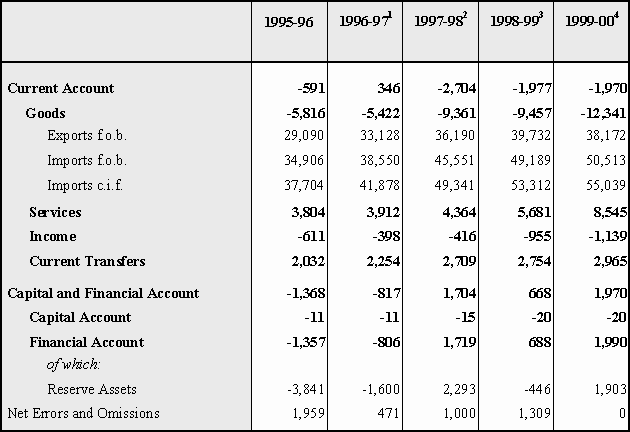
The current account of the balance of payments registered a deficit of Rs1,977 million in 1998-99 compared with a deficit of Rs2,704 million in 1997-98. This improvement in the current account balance in 1998-99 stemmed mainly from an increase in the surplus registered on the services account, from Rs4,364 million in 1997-98 to Rs5,681 million in 1998-99.
As a percentage of GDP, the current account deficit declined to 1.9 per cent in 1998-99 from 3.0 per cent in 1997-98. Excluding the purchase of aircraft, the current account registered a surplus of Rs773 million, equivalent to 0.8 per cent of GDP in 1998-99.
The deficit on the merchandise account of the balance of payments increased from Rs9,361 million in 1997-98 to Rs9,457 million in 1998-99. On a balance of payments basis, in 1998-99, total exports (f.o.b.) rose by 9.8 per cent to Rs39,732 million while total imports (f.o.b.) increased by 8.0 per cent to Rs49,189 million.
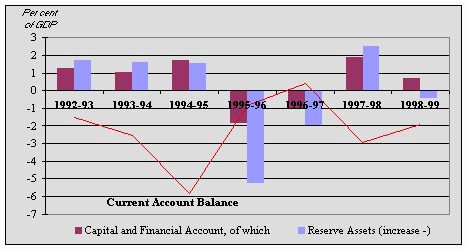
The capital and financial account, inclusive of reserve assets, recorded a net inflow of Rs668 million in 1998-99 compared with a net inflow of Rs1,704 million in 1997-98. The capital and financial account, exclusive of reserve assets, posted a surplus of Rs1,114 million in 1998-99 as against a deficit of Rs589 million in the preceding fiscal year. Table V.1 gives a summary of the balance of payments accounts for the years 1995-96 through 1999-00.
On present trends, a deficit of Rs12,341 million has been projected on the merchandise account in 1999-00, largely on account of the drought-induced fall in sugar exports. However, from a balance of payments perspective, the projected shortfall in sugar export proceeds will be partly cushioned by reinsurance claims from abroad as well as increased earnings from other sectors. The income account is expected to record a deficit of Rs1,139 million. However, the services and current transfers accounts are expected to generate surpluses that would partly offset the projected deficit on the merchandise and income accounts. A deficit of Rs1,970 million has been projected on the current account of the balance of payments.
Table V.1: Balance of Payments Summary
(Rs million)
1
Revised. 2 Revised estimates. 3 Estimates. 4 Projections.Note:
(i) Import data for 1995-96 are inclusive of import of ships and spareparts (Rs789 million).
(ii) Import data for 1996-97 are inclusive of import of aircraft (Rs600 million).
(iii) Import data for 1997-98 are inclusive of import of aircraft (Rs2,473 million).
(iv) Import data for 1998-99 are inclusive of import of aircraft (Rs2,750 million).
Services, Income and Current Transfers
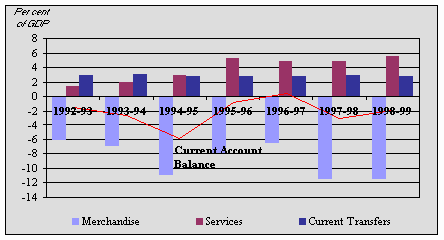
During 1998-99, the services and current transfers accounts continued to make significant positive contributions to the overall balance of payments while the deficit on the income account widened slightly.
The surplus on the services account increased by 30.2 per cent to Rs5,681 million in 1998-99. Gross earnings from tourism went up by 15.8 per cent to Rs12,764 million in 1998-99 as a result of a 1.7 per cent increase in the number of tourist arrivals, from 555,616 in 1997-98 to 565,324 in 1998-99 and a 13.9 per cent increase in average expenditure per tourist. Total visitor nights spent increased from 5,598,000 in 1997-98 to 5,696,000 in 1998-99 while the average length of stay per tourist remained unchanged at 10.1 nights in 1998-99. Expenditure on foreign travel by residents increased by 13.9 per cent to Rs4,637 million in 1998-99. Consequently, net inflows on the travel account increased by 16.8 per cent to Rs8,127 million in 1998-99. The transportation account recorded a deficit of Rs1,903 million in 1998-99 as compared to a deficit of Rs1,893 million in 1997-98. Other services registered a deficit of Rs543 million in 1998-99 as compared to a deficit of Rs699 million in the preceding fiscal year.
The income account recorded a net outflow of Rs955 million in 1998-99 as compared to a net outflow of Rs416 million in the previous year. The net surplus on the current transfers account increased by 1.7 per cent to Rs2,754 million in 1998-99, reflecting a 5.2 per cent increase in net private transfers to Rs2,670 million in 1998-99 and a decrease in net Government transfers from Rs170 million in 1997-98 to Rs84 million in 1998-99.
Chart V.1 shows the main components of the current account for the fiscal years 1992-93 through 1998-99.
Chart V.1: Components of the Current Account
Capital and Financial Account
Direct investment inflows amounted to Rs683 million in 1998-99 compared with inflows of Rs1,233 million in 1997-98. Direct investment outflows amounted to Rs292 million in 1998-99, up from Rs221 million in 1997-98. Consequently, direct investment recorded a net inflow of Rs391 million in 1998-99 compared with a net inflow of Rs1,012 million in 1997-98. During the period under review, portfolio investment, inclusive of the partial redemption of the Floating Rate Note (FRN) amounting to Rs808 million (US$33 million), recorded a net inflow of Rs714 million, largely on account of the repatriation of capital by non-bank institutions.
Loan receipts on account of Government amounted to Rs464 million in 1998-99 while capital repayments stood at Rs836 million. Thus, a net outflow of Rs372 million was registered in 1998-99 compared with a net outflow of Rs275 million in 1997-98. In 1998-99, loan receipts of parastatal bodies, inclusive of the external financing of the order of Rs2,234 million for the purchase of an aircraft, amounted to Rs2,854 million, while capital repayments totalled Rs1,500 million. Thus, net capital inflows on account of parastatal bodies in 1998-99 amounted to Rs1,354 million as compared to net inflows of Rs1,851 million in 1997-98. Other private long-term capital movements recorded a net outflow of Rs430 million in 1998-99 compared with a net outflow of Rs262 million in 1997-98. Net outflows due to the build-up of short-term foreign assets of commercial banks amounted to Rs523 million in 1998-99 compared with net outflows of Rs2,181 million in the preceding year.
Chart V.2 shows the financing of the current account for the fiscal years 1992-93 through 1998-99.
Chart V.2: Financing of the Current Account
Net International Reserves
The net international reserves of the country, made up of the net foreign assets of the banking system, the foreign assets of the Government and the country's Reserve Position in the International Monetary Fund (IMF), increased from Rs21,349 million at the end of June 1998 to Rs22,575 million at the end of June 1999. Gross reserve assets of the Bank of Mauritius went up by Rs446 million to Rs15,315 million at the end of June 1999. The net foreign assets of commercial banks increased by Rs523 million to Rs6,772 million at the end of June 1999.
Under the Eleventh General Review of quotas of the IMF, the quota for Mauritius has increased from SDR73.3 million to SDR101.6 million. Quotas, which reflect members' relative size in the world economy, are normally reviewed every five years. Consequently, in February 1999, the country's Reserve Position in the IMF increased from SDR7.4 million to SDR14.5 million.
In terms of import cover, the level of net international reserves of the country at the end of June 1999 represented 5.4 months of imports, exclusive of the purchase of aircraft, compared with 5.5 months of imports at the end of June 1998. The end-June 2000 level of net international reserves of the country has been projected at Rs20,672 million, equivalent to 4.5 months of imports.
Table V.2 shows the monthly level of net international reserves of the country during the fiscal year 1998-99.
Table V.2: Net International Reserves
(Rs million)
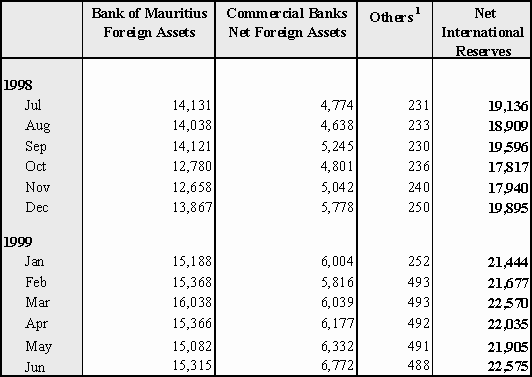
1 Include foreign assets of the Government and the country's Reserve Position in the IMF.
During the fiscal year 1998-99, on the international foreign exchange market, the exchange rate movements of the major international currencies vis-à-vis the U.S. dollar broadly reflected the cyclically divergent growth paths between their respective economies and the U.S. economy. An outstanding achievement during the year was the successful introduction of the European single currency, the Euro, on 1 January 1999.
Reflecting the continued strength of the U.S. economy, the U.S. dollar maintained a firm tone for most of the period under review. However, considerable uncertainty in the U.S. financial markets during August and September 1998, triggered by the financial market crisis in Russia and Latin America, caused a sharp fall in the external value of the U.S. currency against the major international currencies. In its endeavour to shield the U.S. economy from the painful effects of the global crisis while keeping inflationary pressures at bay, the U.S. Federal Reserve reduced its Federal funds rate in the three successive months beginning September 1998 by 25 basis points each time to 4.75 per cent. Following this policy easing, U.S. monetary policy makers subsequently adopted a neutral stance in the absence of inflationary pressures despite continuing rapid growth. However, in the wake of an unexpected broad-based increase in U.S. CPI inflation for April 1999, the Federal Open Market Committee (FOMC), at its May 1999 meeting, maintained interest rates steady but announced that it had, in anticipation of inflationary pressures, shifted its balanced interest rate position held since November 1998 to a tightening bias. Subsequently, in line with market expectations, the U.S. Federal Reserve raised its key interest rate by 25 basis points to 5.0 per cent at its June 1999 meeting. However, the Fed also announced that it had adopted a neutral bias, abandoning the tightening stance of late May 1999.
The Pound sterling maintained a downward trend against the U.S. dollar from July 1998 to mid-August 1998, reaching a low of US$1.6107 amid growing pessimism over the U.K. economy. However, the Pound sterling firmed up thereafter, reaching a high of US$1.7091 at the end of September 1998. The appreciation of the Pound sterling has to be viewed against the backdrop of the turmoil on the Latin American emerging markets. The crisis was expected to hit the U.S. economy more seriously than the British economy due to market perception that the U.S. economy had a relatively larger exposure to the Latin American countries. The British currency remained more or less stable against the dollar up to the third week of October 1998. Meanwhile, the Bank of England cut its base rate by 25 basis points, from 7.50 per cent to 7.25 per cent. Following weak economic prospects in the U.K. and expectations of other interest rate cuts in future, the Pound sterling lost ground and subsequently kept its weak tone against the dollar. At the end of June 1999, the Pound reached a twenty-one-month low of US$1.5744. Since cutting its repo rate to 7.25 per cent in October 1998, the Bank of England reduced its base rate six times to 5.00 per cent in June 1999.
The Japanese yen, which started the fiscal year 1998-99 trading at Y137.80 per dollar closed at Y120.87 per dollar, representing an appreciation of 14.0 per cent against the U.S. currency. The yen weakened sharply during July and August 1998, reaching a low of Y147.63 per dollar on 11 August 1998, marred by deflationary risks to the Japanese economy. Growing awareness of the severity of Japan's recession and uncertainty over government policies to stimulate the Japanese economy and the financial system continued to weigh on the yen. However, from September 1998 to January 1999, the yen recovered against the dollar, largely supported by the announcement of new initiatives in the banking sector by the Japanese authorities. Furthermore, a sharp rise in Japanese Government Bond yields that resulted in a narrowing yield differential between the U.S. and Japanese government bonds also contributed to the appreciation of the yen. From mid-February 1999 onwards, the yen traded within a range of Y115 and Y125 per dollar. Yen-selling intervention by the Bank of Japan coupled with comments by Japanese officials helped to stabilise the yen.
Between end-July 1998 and end-December 1998, the Deutsche mark appreciated on a point to point basis by 7.7 per cent against the U.S. currency. It partly benefited from its safe-haven appeal as concerns about events in Latin America made dollar-buying risky. Moreover, there was strong buying interest in the currencies of those countries that later formed part of the euro area.
On 1 January 1999, the single currency, the Euro, was launched but official trading started three days later in Sydney. At its opening debut, the Euro traded at US$1.1747, up from US$1.1668, the closing rate of the ECU on 31 December 1998. Strong demand for the new currency brought about its rapid appreciation against the dollar to US$1.1927 in the first few days. However, as the euphoria over the birth of the single currency subsided, the Euro lost ground against the U.S. dollar. From US$1.1747 at its launch, the Euro depreciated by more than 12 per cent to attain a low of US$1.0269 in early June 1999, recovering marginally thereafter to reach US$1.0330 by the end of June 1999. The weakening of the Euro vis-à-vis the U.S. dollar was mainly driven by the widening cyclical mismatch between the U.S. economy and the euro zone. Market participants focused on the relatively more optimistic economic outlook in the U.S. as compared to the uncertainty about economic growth and persistently high unemployment rates affecting the euro area. Despite the European Central Bank (ECB) reducing its interest rate by 50 basis points to 2.5 per cent in April 1999 to boost growth in the euro zone, the single currency remained under pressure. Furthermore, hostilities in the Balkan region contributed to some extent to the Euro weakness. The decision by the Finance Ministers of the euro zone in May 1999 to allow Italy to relax its budget deficit target from 2.0 per cent of GDP agreed under the Stability and Growth Pact to 2.5 per cent for 1999 also weighed on the Euro. In addition, European policymakers’ apparent lack of concern at the Euro’s slide contributed to its decline.
Between 1997-98 and 1998-99, based on daily average, the U.S. dollar depreciated against the French franc, Deutsche mark and Japanese yen by 2.3 per cent, 2.3 per cent and 2.0 per cent, respectively, but appreciated vis-à-vis the Pound sterling by 0.4 per cent.
Table V.3 shows the exchange rate movements of the Mauritian rupee vis-à-vis major trading partner currencies.
Table V.3: Exchange Rate Movements of the Rupee vis-à-vis Major Trading Partner Currencies
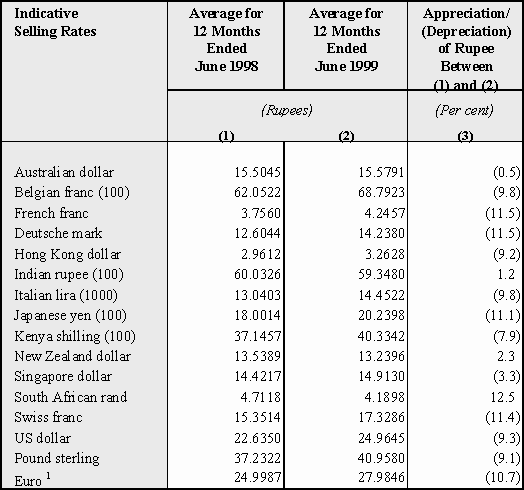
1
Effective 1 January 1999, the Euro (EUR) was introduced replacing its precursor, the ECU, on a one-to-one basis.Notes:
(i) With effect from 8 September 1998, there are no dealings for the Malaysian ringgit on account of its withdrawal from the international financial system.
(ii) With effect from 1 October 1998, the daily average exchange rate of the Rupee is based on the average selling rates for T.T. and D.D. of all commercial banks.
(iii) With effect from 10 June 1999, there are no dealings for the China yuan.
The reorientation of monetary policy towards the end of 1998 has brought about a better integration of monetary and exchange rate policy. This has imparted greater stability to the exchange value of the rupee during the second half of the fiscal year 1998-99 and has also enhanced the attractiveness of rupee-denominated assets. Exchange rate movements during the period under review have reflected both international trends and local market conditions.
During the fiscal year 1998-99, the U.S. dollar maintained a general upward trend against the rupee, moving within a low of Rs24.42 on 1 July 1998 and a high of Rs25.40 on 17 June 1999. At the close of business on 30 June 1999, the dollar was quoted at Rs25.39.
The Pound sterling weakened against the rupee during July and August 1998, reaching a low of Rs39.80 on 18 August 1998. Thereafter, it recovered reaching a peak of Rs42.33 on 21 October 1998. From then on, the Pound sterling declined vis-à-vis the rupee to reach Rs39.97 at the end of June 1999.
Reflecting its movement against the U.S. dollar on the international foreign exchange market, the Japanese yen remained weak against the rupee during the first two months of the fiscal year 1998-99, reaching a low of Rs16.85 per 100 Yen around mid-August 1998. However, from mid-August 1998 to January 1999, the yen firmed up vis-à-vis the rupee reaching a peak of Rs22.68 per 100 Yen on 11 January 1999. In early March 1999, the yen resumed its downward movement against the rupee to trade at Rs20.55 per 100 Yen; it subsequently remained fairly stable moving within a range of Rs20.55 to Rs21.55 per 100 Yen. The Japanese yen closed the fiscal year 1998-99 at Rs21.10 per 100 Yen.
At the beginning of the fiscal year 1998-99, the ECU was trading at Rs26.82. It peaked at Rs30.25 on 8 October 1998 but closed lower at Rs29.17 at the end of December 1998. A similar trend was observed for the Deutsche mark and French franc. These two currencies maintained a general upward trend against the rupee during the third quarter of 1998 until mid-October 1998 when both the German and French currencies reached a peak of Rs15.34 and Rs4.56, respectively. On 1 January 1999, the Euro was introduced replacing the ECU on a one-to-one basis, and the Deutsche mark and French franc, along with the other nine euro zone currencies, became monetary units of the Euro linked to the single currency by irrevocably fixed conversion rates. On the first day of official trading, 4 January 1999, the Euro traded at Rs29.46. Reflecting its downward movement on the international foreign exchange market, the single currency maintained a general downward trend against the rupee throughout the period January 1999 to June 1999. The Euro fell from its high of Rs29.46 on 4 January 1999 to a low of Rs26.13 in early June 1999. At the end of June 1999, the Euro traded at Rs26.22, returning to levels that applied during the first three weeks of April 1998. The Deutsche mark and French franc paralleled the Euro's movement and retained a weak tone against the rupee to trade at Rs13.40 and Rs4.00, respectively, at the end of June 1999, after reaching a low of Rs13.36 and Rs3.98 on 7 June 1999.
Chart V.3 shows the trends in the daily bilateral exchange (selling) rates of the rupee against the Deutsche mark, French franc, Japanese yen, U.S. dollar, South African rand, Pound sterling and the Euro.
Chart V.3: Exchange Rate of the Rupee


Interbank Foreign Exchange Market
During 1998-99, activity on the interbank foreign exchange market remained rather subdued. Total transactions during this period reached an equivalent of US$67.68 million as compared to US$179.25 million in 1997-98.
The monthly average level of transactions was US$5.64 million in 1998-99, lower than the monthly average of US$14.94 million registered in 1997-98. Interbank transactions reached a peak of US$12.80 million in December 1998 and a trough of US$2.38 million in May 1999. The opening interbank Rs/US$ ask rate during the period under review moved in the range of 24.24-25.21.
Table V.4 gives details of monthly transactions on the interbank foreign exchange market.
Table V.4: Interbank Foreign Exchange Market
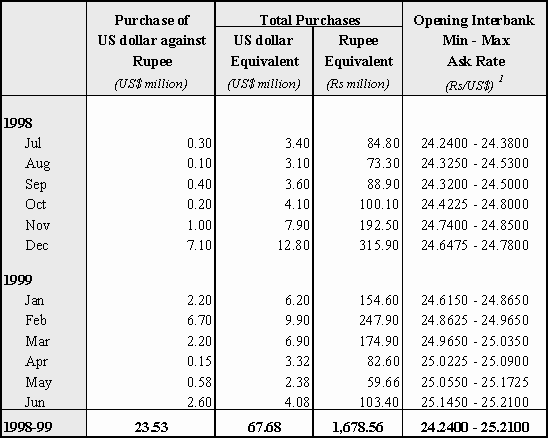
1 With effect from 1 October 1998, the Rs/US$ ask rate is based on the average of daily
Rs/US$ ask rate of four major commercial banks.
During 1998-99, the Bank of Mauritius, through intervention on the interbank foreign exchange market, sold US$126.60 million to commercial banks and purchased US$11.00 million from them. In March 1999, the Bank of Mauritius also purchased EUR3.0 million, equivalent to US$3.3 million, from commercial banks.
Table V.5 shows monthly intervention and related transactions of the Bank of Mauritius on the interbank foreign exchange market during 1998-99.
Table V.5: Intervention and Related Transactions of the Bank of Mauritius on the Interbank Foreign Exchange Market
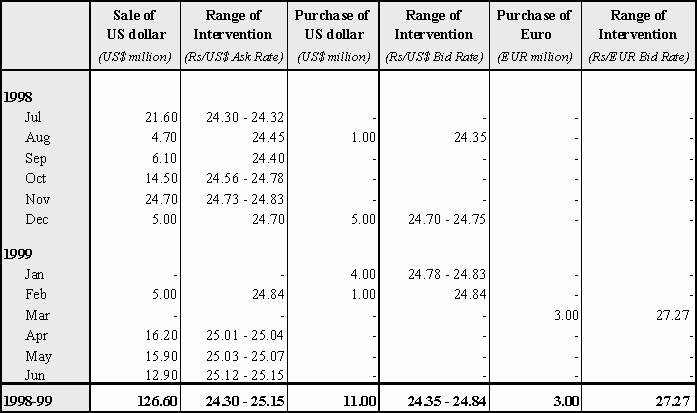
During 1998-99, direct sales of foreign currencies by the Mauritius Sugar Syndicate (MSS) to commercial banks amounted to an equivalent of US$281.4 million whereas the Bank of Mauritius injected a net amount of US$112.3 million on the interbank foreign exchange market. Thus, total net sales by the Bank of Mauritius and the release of foreign currencies by the MSS directly on the interbank foreign exchange market exceeded commercial banks’ shortfall in foreign exchange by US$83.7 million.
Table V.6 summarises the monthly inward and outward remittances of commercial banks during 1998-99.
Table V.6: Inward and Outward Remittances of Foreign Currencies of Commercial Banks

|
Public Information Notice following the
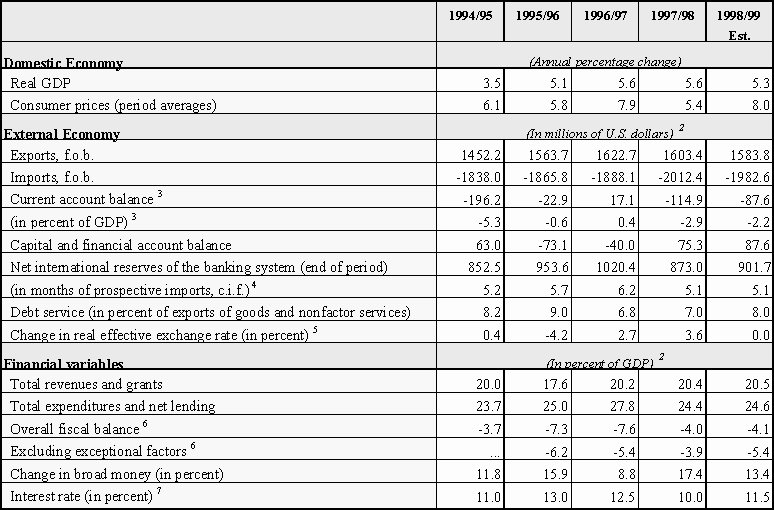
conclusion of the 1999 IMF Article IV Consultation with Mauritius On August 3, 1999, the Executive Board concluded the Article IV consultation with Mauritius1. Background During the period July 1998-June 1999, and in the wake of the turbulence in the global economy, overall economic activity in Mauritius remained buoyant, with real GDP growth estimated at 5 1/3 percent. The expansion continued to be broad based, with significant contributions recorded in manufacturing (especially in the export processing zone-EPZ), financial and business services (including offshore activities), trade (including tourism), and other services (particularly transport and communications). However, the pace of inflation quickened to an estimated 8 percent from 5 1/3 percent in 1997/98. This pickup reflects the introduction of a value-added tax (VAT) in September 1998; the ongoing drought; the continued rapid expansion of bank credit to the private sector; and the lagged impact of the depreciation of the Mauritian rupee (10 percent vis-à-vis the U.S. dollar in nominal terms) in the aftermath of the Asian currency crises. Moreover, the rate of unemployment, although still relatively low (5 3/4 percent in 1997/98), is likely to have edged up further in an environment characterized by an increasing mismatch in labor skills and inadequate labor market flexibility. With buoyant tax receipts (particularly from the recently implemented VAT) and nontax revenues, the overall fiscal deficit in 1998/99 (including grants and exceptional factors such as the proceeds from the sale of fixed assets) is estimated to have remained at some 4 percent of GDP, despite higher-than-expected off-budget outlays. However, the underlying fiscal deficit (including grants but excluding exceptional factors) is likely to have widened to about 5 1/3 percent of GDP. The government is likely to have met its financing needs entirely from domestic nonbank sources and, for the first time in the 1990s, to have made net repayments to the banking system. At the same time, however, commercial banks sharply expanded credit to the private sector, largely in the form of tax-free company debentures. In the area of prudential requirements, effective January 1, 1999, the Bank of Mauritius raised the minimum paid-up or assigned capital for both domestic and offshore banks from Mau Rs75 million to Mau Rs100 million. In 1998/99, Mauritius is estimated to have recorded a smaller external current account deficit (including the acquisition of aircraft and ships) of just over 2 percent of GDP, compared with 3 percent in 1997/98, owing principally to a substantial rise in tourism-related earnings and lower petroleum import prices. Net international reserves of the banking system are estimated to have remained at a 5-month import cover at end-June 1999. Moreover, Mauritius continues to have a low external debt-service ratio; during 1998/99 this ratio is estimated to have increased slightly to 8 percent of exports of goods and services from 7 percent in 1997/98, largely reflecting an early repayment on a floating-rate note. The real effective exchange rate of the Mauritian rupee (on a period-average, bilateral-trade-weighted basis) appreciated by 3 1/2 percent in 1997/98 and remained unchanged over the July-December 1998 period.
Executive Board Assessment Executive Directors welcomed the Mauritian authorities' success in maintaining buoyant economic activity in the wake of turbulence in the global economy. At the same time, however, Directors noted that the pace of inflation had quickened, unemployment had likely edged up further, and the near-term prospects had been weakened by a serious drought. Directors were therefore encouraged by the authorities' resolve to move forward with some key policy adjustments and reforms to meet the challenges in the period ahead, despite the difficult present circumstances. Directors supported the authorities' intention to embark on a course of phased fiscal consolidation, taking into account the need to address the country's social needs. They noted that fiscal adjustment would rely primarily on higher revenues from the improved administration of the value-added tax and a downsizing of the civil service. In this connection, Directors also strongly encouraged the authorities to scale down the large number of tax exemptions and concessions. They stressed the need for the authorities to restructure government expenditure, so as to provide adequate resources for much-needed vocational training to address the increasing mismatch in labor skills. Directors commended the authorities for placing importance on continued government net repayments to the banking system to achieve the required monetary restraint. They cautioned, however, that it would also be essential for the authorities to discontinue the tax-free status of company debentures; to develop, as intended, full-fledged open-market operations to gain greater monetary control through indirect instruments; and to ensure the coordination of domestic liquidity and treasury cash management needs. Directors underscored the need for a further strengthening of prudential requirements and banking supervision, given the relatively high level of nonperforming loans and low loan provisioning by banks, as well as the high concentration ratios in the banking system. Directors urged the authorities to expedite passage of long-overdue revisions to the Bank of Mauritius and Banking Acts. In the present global environment, Directors welcomed the authorities' intention to continue their policy of allowing the exchange rate of the Mauritian rupee to adjust to underlying market pressures. Directors took note of the steps that have been taken in the context of the 1999/2000 government budget to liberalize the tariff regime. However, they favored a more ambitious move to lower tariff rates, in concert with higher value-added tax revenue collections and consistent with regional commitments, so as to foster external competitiveness and the expansion of employment. To achieve these objectives, it would also be necessary for the authorities to press ahead with their efforts to replace the outmoded tripartite wage negotiation system, and to revise laws governing labor shedding to allow appropriate labor market flexibility. However, it was recognized that the potential social effects of such a transition should be taken into account. Directors also emphasized the need for the authorities to promote greater market competition, notably for petroleum products and cement. Directors supported the authorities' policy of providing mainly legislative support for private sector initiatives in Mauritius and abroad. In this connection, they emphasized the need to adopt unambiguous and transparent guidelines in order to encourage investment in Mauritius. While recognizing that Mauritius's economic and financial data were satisfactory for surveillance purposes, Directors encouraged the authorities to intensify efforts to provide the Fund with annual estimates and projections for the fiscal accounts and balance of payments. |
Mauritius: Selected Economic Indicators1
Sources: Mauritian authorities; and IMF staff estimates.
1
Fiscal year from July to June.August 18, 1999
The 1990’s were marked by the globalisation of economic activities. Greater interdependence among countries started with the formation of regional economic groups in the 1970's and the 1980's. Around the globe regional groupings flourished as countries joined together in order to have access to goods and capital markets and not be marginalised. In Africa, we have the Organisation of African Unity/African Economic Community, the Economic and Customs Union of Central African States, the Economic Community of the West African States, the Common Market for Eastern and Southern Africa (COMESA), the Southern African Development Community (SADC). In the Indian Ocean, there are the Indian Ocean Commission and the Indian Ocean Rim Association for Regional Cooperation.
Both integration and the benefits to be derived from it take a lot of time. In spite of the efforts made by these regional organisations, the share of sub-Saharan Africa in world trade is still negligible. There is a general feeling that things are not moving fast enough and various reasons have been put forward to explain this: conflicting regional groups with overlapping projects; the need to have authority from the ruling government before taking initiatives and adopting projects; open conflicts in many countries; and, the reluctance to take trade liberalisation and facilitation measures.
In adopting the work programme of these organisations, governments, enterprises and workers are very often affected. Special mechanisms have to be put in place to help enterprises and workers cope with these problems. Governments stand to lose a lot of revenue through their commitment to trade liberalisation and facilitation at the regional and international levels. Within the Cross-Border Initiative, the co-sponsors, namely the European Commission, World Bank, African Development Bank and the IMF, have agreed to bear the transitory costs of regional integration.
One criticism levelled at regional organisations is the lack of dialogue and communications between them. This can cause a duplication of activities and even contradictions in terms of commitments taken at the level of the various organisations. In April 1999, a meeting was organised between COMESA and Finance and Investment Sector Coordinating Unit (FISCU) officials and each party was briefed on the activities of the other.
The SADC was officially established in August 1992 in Windhoek, Namibia. Mauritius joined the SADC in August 1995. Today, SADC regroups 14 member states, namely Angola, Botswana, Democratic Republic of Congo, Lesotho, Malawi, Mauritius, Mozambique, Namibia, Seychelles, South Africa, Swaziland, Tanzania, Zambia and Zimbabwe.
The key sectors in SADC are: Trade and industry; Food, agriculture and natural resources; Energy; Transport and communications; Human resources development; Mining; Tourism; Culture and information; Finance and investment; Water; Employment and labour. Each member state of SADC is allocated a sector to coordinate. Mauritius is the coordinating country for Tourism.
Mauritius hosted the meeting of the SADC Heads of States in September 1998. The summit was to a large extent dominated by debates on the conflict in the Democratic Republic of Congo. There was also the signature of the Tourism protocol by the 14 member states.
The member states have decided, at a workshop held in Gaborone, Botswana, in April 1999, to create an Association of the Chamber of Commerce of the SADC countries. Among the objectives of the Association are the promotion of trade and investment within the SADC region, the coordination of views of the various private sector organisations of SADC, the development of various ways to communicate and collaborate with other institutions like the SADC Secretariat and the promotion of a competitive manufacturing sector at the level of individual member state. Mauritius has been given the presidency of the Association for the next two years and she will also act as secretariat to the Association. As a first step, the Association will seek to obtain the official approval of the political instances of SADC and to sign a Memorandum of Understanding with the SADC Secretariat that will define avenues of cooperation.
Trade between Mauritius and SADC countries registered a drop in 1998. From Rs5,920 million in 1997, our imports from SADC countries dropped to Rs5,630 million and our exports to SADC countries also registered a fall, dropping from Rs550 million to Rs483 million. The bulk of the transactions related to trade with South Africa, which accounted for 93 per cent of our imports and 39 per cent of our exports.
In January 1995, the Council of Ministers decided to create the Finance and Investment Sector and to allocate it to South Africa. The sector comprises two Committees: the Committee of Central Bank Governors, which attends to monetary policy and financial issues and the Committee of Treasury Officials, which attends to fiscal policy issues. Both Committees report separately to the Committee of Ministers of Finance. The South African Reserve Bank coordinates the activities of the Committee of Central Bank Governors and FISCU coordinates the work of the two committees. The inaugural meeting of the Committee of Governors was held on 24 November 1995.
One of the most important items on FISCU's agenda is the SADC Finance and Investment Protocol. Following the three comprehensive studies commissioned by FISCU on investment, development finance and macroeconomic issues, a first draft of the new protocol was expected to be tabled at the Meeting of the Committee of Finance Ministers in July 1999. However, because of internal problems within FISCU, this has been delayed. It is hoped that with the appointment of a new Director and Deputy-Director, things will be moving much faster.
Attracting investment flows to the SADC region is one of the major objectives of the sector. To achieve this, a sound financial accountability framework and adherence to international auditing and accounting standards are essential. Since 1997, the sector has been working on this issue, focussing on five main areas, namely accounting, auditing and government accountability, business law, education and training, and internal audit in the public sector. A study examining the feasibility of the programme has been completed. The main aspects of the study relate, inter alia, to the creation of a regional body that will be responsible for the governance of the accounting and auditing profession throughout the SADC region, the effectiveness and independence of Auditors-General in the region and the harmonisation of commercial law in SADC. All the recommendations and the way forward will be discussed at a forthcoming workshop.
The last meeting of the Committee of Central Bank Governors was held in Swaziland on 9 April 1999. It was attended by Governors of thirteen of the fourteen member central banks as well as representatives from the Finance and Investment Sector Co-ordinating Unit (FISCU), the SADC Secretariat, the SADC Banking Association and the Committee of Stock Exchanges in SADC.
The Committee discussed the impact of the global financial crisis on exchange rate policies in SADC member countries. In addition, views on the effect of the increasing volatility in international capital flows on the economies of SADC member states in the face of financial liberalisation, were exchanged. Each central bank gave a review of its status regarding Year 2000 readiness and progress made in establishing National Year 2000 committees in their respective countries. Several workshops aimed at capacity building, addressing the Year 2000 problem and enhancing awareness of emerging technologies and new business practices, are scheduled in the months ahead.
The meeting also reviewed progress made with existing projects and initiatives, including the development and automation of the statistical database, payments, clearing and settlement systems, the training of central bank officials and the legal and operational frameworks of SADC central banks. In addition, progress on the latest projects and initiatives, namely, the role of SADC central banks in the operations and development of money markets and interaction in the area of central bank protective services in the region, was also reviewed.
Autonomous SADC substructures such as the Committee of Stock Exchanges and the Banking Association, which liaise with and report to the SADC Ministers of Finance through the Committee of SADC Central Bank Governors, submitted progress reports in their respective areas. Efforts taken by these structures to foster and promote regional cooperation were noted. A progress report outlining the activities of East and Southern Africa Banking Supervisors Group (ESAF) was also submitted. The Committee of Governors further noted progress with the drafting of the Finance and Investment Sector Protocol for the SADC region.
The Committee of Governors paid tribute to Dr Stals, who retired in August 1999, for his contribution to the establishment of the Committee of Central Bank Governors in the Finance and Investment Sector of SADC. As Chairman of the Committee since its inception in 1995, he has been a major driving force for closer cooperation in the SADC region.
The Committee’s next meeting will be held in South Africa on 13 to 15 October 1999.
The Common Market for Eastern and Southern Africa (COMESA) was established in December, 1994, to replace the Preferential Trade Area for Eastern and Southern African States (PTA), which had been in existence since 1981. All countries in Eastern and Southern Africa are eligible to become members of COMESA. Currently, there are 21 member states with a population of over 385 million and an annual import bill of US$32 billion. COMESA states have undertaken to remove all internal trade tariffs and barriers by the year 2000 and to introduce by the year 2004 a common external tariff structure for trade with third parties. Many SADC countries are members of the COMESA.
As part of this process, there is the Monetary Harmonisation Programme, which started in 1991 and is planned to be implemented in four phases. Most countries have made a lot of progress in the first phase, which consists in removing all restrictions on imports from all COMESA countries. In addition, they have to adopt flexible exchange rates. The second stage consists in achieving limited currency convertibility and completing macroeconomic convergence. In the third phase, there will be an exchange rate union that will allow currencies of member countries to fluctuate within a given margin and also a common monetary authority. In the final stage, a common currency will be introduced.
One of the major developments within COMESA was the restructuring of the COMESA Clearing House. Based in Harare, it was set up in the 1980's by the Preferential Trade Area. The value of transactions settled through the COMESA Clearing House has fallen drastically since the beginning of the 1990's. With the liberalisation of current account transactions and the gradual removal of exchange controls in almost all the countries of the region, the Clearing House could no longer carry out its main objective, namely to facilitate the settlement of payments for intra-regional transactions in goods and services. Its closure appeared inevitable, unless it was given new responsibilities. It was in that perspective that Governors of central banks of COMESA decided in Maputo, Mozambique in 1996, that the COMESA Clearing House should engage in new activities and provide new services that would help to promote regional integration. In addition, it should be open to all countries of the region and also to the private sector, with direct involvement of commercial banks and other key market players.
The Clearing House was renamed the Regional Export Services Agency (RESA). Its secretariat carried out a Needs Assessment Survey of the Banking and Business Sectors in June 1998. Based on that survey, the Secretariat will provide the following triad of services:
- a Regional Trade Facilitation Project (formerly Africa Guarantee Facility) in order to mitigate the political risk associated with trade for terms of up to 3 years, thereby facilitating the availability of trade finance and reducing trade costs
- a Fast Payment Facility in order to provide certainty and quickness of payment to exporters while doing away with the need for outside confirmation
- a SWIFT Regional Service Centre in order to ensure secure and instantaneous credit.
RESA will be set up with US$200 mn loan capital, sourced from the World Bank in the form of IDA credits to interested Governments. These funds would be complemented by share capital of US$20 million in Government contributions and US$20 million of private capital. The Regional Trade Facilitation Project will be set up in order to cover political risk whenever an economic agent such as Afrexim and the PTA Bank is willing to cover the commercial risk. In addition, discussions have been held with the Society for Worldwide Interbank Financial Telecommunication (Swift) in Brussels with a view to making the Clearing House a Regional Service Centre for Swift.
Total trade with COMESA countries registered an increase, going up from Rs3.0 billion in 1997 to Rs3.6 billion in 1998.
The Indian Ocean Rim Association for Regional Cooperation (IOR-ARC) is an association open to all sovereign states of the Indian Ocean Rim. The first Ministerial Meeting of the IOR-ARC was held in Mauritius from 5 to 7 March, 1997. Currently, there are 14 countries which are members of the IOR-ARC, namely Australia, India, Indonesia, Kenya, Madagascar, Malaysia, Mauritius, Mozambique, Oman, Singapore, South Africa, Sri Lanka, Tanzania and Yemen. In addition, at the last Ministerial Meeting held in Maputo, Mozambique, the membership of five other countries has been officially approved. They are Bangladesh, Iran, Seychelles, Thailand and the United Arab Emirates. Pakistan would adhere to the Association once it signed the non-discriminatory treaty on education and trade. The request made by Egypt and Japan to have a status of dialogue partners has also been approved.
In the first phase of the project, the aim was simply to launch the organisation and decide on its structures. Member countries will now expect the second phase to be more ambitious and will want to see concrete achievements and significant benefits starting to accrue. One of the first challenges will be to help member states to adjust to globalisation and to the more liberalised trade regime as advocated by the WTO and the phasing out of the Multi-Fibre Agreement and the Sugar Protocol.
On 16 July 1999, the US House of Representatives passed the Africa Bill by a vote of 234-163. The Bill would authorise quota-free and duty-free imports of textile and apparel products from sub-Saharan Africa. Import taxes of 15-25 per cent are now imposed on Africa-made textiles. It is now expected that the Bill will move to the Senate around mid-September 1999. However, the Senate version will differ from that of the House of Representatives: on textile, it would require that African countries use American raw materials when manufacturing textile exports for the American market. The powerful American Textile Manufacturers’ Institute fears that the Bill would allow cheap textile products from South East Asian countries to enter the American market or would encourage entrepreneurs from these countries to set up units in Africa for the assembly of pre-cut fabric into textile products for export to the US.
Although it is believed that the approval by Senate would constitute a major step in the enactment of the Africa Bill into law, the House of Representatives and Senate members will still have to meet in order to decide on whether all quotas and taxes will be removed. Only then will they finalise the Bill. It is this final version that will be presented to the US President for his signature. In view of the phasing out of the Multi-Fibre Agreement by the year 2005, the rejection of the Bill would be a major set back for Mauritian textile products as this would entail competing with countries like China, India, Pakistan and Bangladesh.
|
VII. INTERNATIONAL ECONOMIC DEVELOPMENTS |
After the slowdown of world growth from 4.2 per cent in 1997 to 2.5 per cent in 1998, the forecast for 1999 has been revised down to 2.3 per cent. Developments in the world economy in the year 1998 indicated that the Asian crisis intensified and lingered on until October 1998. The crisis in Russia in mid-August 1998, coming in the wake of the Asian crisis, led to a drying up of private financial flows to emerging markets and there were fears that the economic slowdown would continue to deepen and widen in 1999. However, the easing of monetary conditions in industrial countries, together with other policy actions since early October 1998, helped to contain the crisis in financial markets. The crisis in Brazil that led to the devaluation of the Brazilian real in mid-January 1999 had limited contagious effects. Nevertheless, these bouts of instability clouded the prospects for an early pickup in financial flows and in world growth in 1999. The overall impression in mid-1999 was that financial markets in Asia had stabilised and that the deep recession seen in many Asian economies had bottomed out. Conditions in mature financial markets have also improved following the timely policy response to the threat of a credit crunch that came in the wake of the Russian crisis. A significant factor underpinning the improvement in prospects over the past year or so was the continuing strength of the U.S. economy. Subdued inflation, which allowed interest rates to remain at low levels, was instrumental in the maintenance of the strong growth momentum. Inflation in Europe also remained low, and this may be to some extent attributable to the introduction of the Euro and the lowering of interest rates in most countries. Of the major industrial countries, only Japan failed to advance during 1998.
Growth of output in the major industrial countries, on average, declined from 3.0 per cent in 1997 to 2.2 per cent in 1998. It is expected to decline further to 1.9 per cent in 1999. Growth of output in the U.S., sustained by strong growth in domestic demand, which was in turn fuelled by robust gains in employment and wages, low interest rates and the sizeable additions to household wealth associated with the buoyancy of the stock market, matched its 1997 pace of 3.9 per cent. Inflationary pressure and other, potentially unsustainable, imbalances in the economy are likely to dampen growth to a projected 3.3 per cent in 1999. In the European Union (EU), the achievements in reducing fiscal imbalances, inflation and nominal interest rates contrast sharply with the generally poor growth performance and persistently high unemployment in much of continental Europe. Growth of output in the EU countries, on average, rose from 2.7 per cent in 1997 to 2.8 per cent in 1998 but is projected to fall to 1.8 per cent in 1999. Although growth in the euro area somewhat strengthened in 1998, it had shown signs of weakening anew in the first half of 1999 as the external environment deteriorated in the wake of the crisis in emerging market economies. After increasing from 2.5 per cent in 1997 to 2.9 per cent in 1998, growth in the countries of the euro zone would average around 2 per cent in 1999. In the U.K., following several years of expansion at above-potential rates, growth slowed markedly during 1998, falling to 2.1 per cent from 3.5 per cent in 1997, and is expected to weaken further to 0.7 per cent in 1999. The slowdown stemmed from the tightening of monetary conditions between late 1996 and early 1998 and the substantial appreciation of the Pound sterling, the impact of fiscal consolidation undertaken in recent years, and the deceleration of global growth. The weakening of net exports, apparent since mid-1997, has been accompanied in 1999 by a marked slowdown of domestic demand. Japan was among the first countries to feel the adverse trade impact from the crisis in emerging Asian economies. Moreover, with private demand responding only little to expansionary fiscal and monetary policies, the recession, which had started in early 1997, deepened. Japan's real GDP growth fell from 1.4 per cent in 1997 to -2.8 per cent in 1998 and is expected to be -1.4 per cent in 1999. Growth of output in other advanced economies declined from 4.5 per cent in 1997 to 1.1 per cent in 1998, but is expected to pick up to 2.3 per cent in 1999.
In the developing economies, as a group, growth of output fell from 5.7 per cent in 1997 to 3.3 per cent in 1998 and is expected to fall further to 3.1 per cent in 1999. African economies, on average, registered an increase in their growth from 3.1 per cent in 1997 to 3.4 per cent in 1998 and are expected to grow at a slightly lower rate of 3.2 per cent in 1999 due to the sluggish global growth picture and weak commodity prices. While Africa has escaped the worst of the recent financial contagion because it has not yet fully integrated into the global economy, it has also reaped few of the benefits of globalisation, such as the chance to quicken the pace of investment, job creation, and growth. After the deep output contractions in Asia's crisis-afflicted countries, activity has turned around in Korea and bottomed out in Malaysia and Thailand. Moreover, the rest of Asia seems to be recovering in 1999. Financial stabilisation, with strengthening exchange rates allowing monetary policies to be relaxed further, together with supportive fiscal policies and improvements in confidence, domestically and abroad, stepped up the progress toward economic recovery. Most countries in Latin America experienced sharp economic slowdown during the second half of 1998 as a result of the decline in private capital inflows and the weakening of the prices of commodity exports. Growth in the Western Hemisphere countries fell from 5.2 per cent in 1997 to 2.3 per cent in 1998, and output is projected to decline by 0.5 per cent in 1999.
After a growth rate of 2.2 per cent in 1997, transition economies, as a group, registered a contraction of 0.2 per cent in 1998, and output in 1999 is expected to deteriorate further by 0.9 per cent. In contrast to the success of most other transition economies in escaping from the emerging market turmoil, the Russian economy plunged into deep crisis following the collapse of its foreign exchange and financial markets in the wake of the devaluation of the rouble and the unilateral restructuring of its domestic debt in August 1998. Russia's GDP growth fell from 0.8 per cent in 1997 to -4.8 per cent in 1998 and is likely to deteriorate further to -7.0 per cent in 1999. Developments in Russia, nevertheless, have had significant adverse effects on near-term growth prospects and balance of payments positions in a number of the neighbouring countries in transition.
The year 1998 has been marked by a sustained fall in world inflation. Inflation in advanced economies, as measured by consumer prices, dropped to 1.6 per cent in 1998 from 2.1 per cent in 1997 and is likely to fall further to 1.4 per cent in 1999. Inflation in the U.S. fell from 2.3 per cent in 1997 to 1.6 per cent in 1998. The U.S. Federal Reserve cut rates thrice in late 1998, from 5.5 per cent to 4.75 per cent, in response to the deepening international financial crisis. At the end of June 1999, it raised rates to 5.0 per cent as a preemptive measure against inflation. In the U.K., the inflation rate fell from 2.8 per cent in 1997 to 2.7 per cent in 1998 and is expected to remain steady in 1999. With inflation close to its target of 2.5 per cent and with continued weak growth prospects, the Bank of England has lowered short-term interest rates since October 1998, from 7.5 per cent to 5.0 per cent in June 1999. Monetary conditions were also eased by a moderate depreciation of the Pound sterling since early 1998. Inflation in the euro zone declined from 1.7 per cent in 1997 to 1.3 per cent in 1998 and is expected to go down further to 1.0 per cent in 1999. The European Central Bank (ECB) set its repo rate at 3.0 per cent in December 1998. But with inflation in the euro area below the middle of the target range and short-term growth prospects remaining weak, the ECB lowered the repo rate by an additional 50 basis points in early April 1999 to 2.5 per cent. Inflation in Germany fell from 1.8 per cent in 1997 to 0.9 per cent in 1998 and is expected to fall to 0.6 per cent in 1999. France also registered a decrease in its inflation rate from 1.2 per cent in 1997 to 0.7 per cent in 1998 and expects a further fall to 0.5 per cent in 1999. In other advanced economies, on average, inflation rose marginally from 2.6 per cent in 1997 to 2.7 per cent in 1998, but is expected to fall to 1.3 per cent in 1999. In the developing countries as a whole, the rate of inflation increased slightly from 9.4 per cent in 1997 to 10.4 per cent in 1998 but is expected to fall to 8.8 per cent in 1999.
Between end-June 1998 and end-June 1999, on the international foreign exchange market, the U.S. dollar appreciated against most other major international currencies, reflecting the relative buoyancy of the U.S. economy and the associated wide interest rate differentials in favour of dollar-denominated assets. During August and September 1998, however, considerable uncertainty in U.S. financial markets, triggered by the financial market crisis in Russia, led to a depreciation of the U.S. currency. Between end-June 1998 and end-June 1999, the yen appreciated by 14.0 per cent against the U.S. dollar. After weakening in July and August 1998, amid growing awareness of the severity of the Japanese recession and uncertainty over government policies, the yen strengthened against the dollar from September 1998 to January 1999, supported by the announcement by the Japanese authorities of new initiatives in the banking sector. Thereafter, yen-selling intervention by the Bank of Japan coupled with comments by Japanese officials helped to stabilise the yen. The Pound sterling was generally firm against the dollar in the second half of 1998, with, however, some fluctuations. The weakening of growth and easing of monetary policy in the U.K. contributed to a depreciation of the Pound sterling against the U.S. dollar in the first half of 1999. At the end of June 1999, the Pound sterling fell to US$1.5744, its lowest level against the dollar since September 1997.
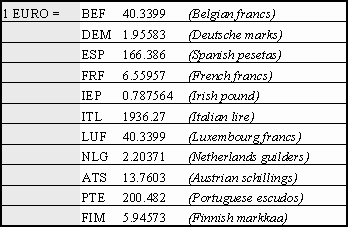
The Euro made its debut on the international foreign exchange market on 4 January 1999, replacing its precursor, the ECU, on a one-to-one basis. The eleven member states of the euro zone irrevocably fixed their currencies to the Euro.
Table VII.1 shows the irrevocably fixed conversion rates between the Euro and the currencies of the eleven participating countries.
Table VII.1: Fixed Euro Conversion Rates
After the initial bullish sentiment toward the Euro, the single currency lost ground rapidly due to poor growth prospects in the euro zone and the relative strength of the U.S. economy. The apparent lack of concern of European Central Bank officials over the Euro's decline also weighed on the latter.
World trade in goods and services registered a decline in its growth, from 9.9 per cent in 1997 to 3.3 per cent in 1998. Growth in world trade is expected to pick up slightly to 3.8 per cent in 1999. Advanced economies witnessed a slowdown in the expansion of their volume of exports from 10.3 per cent in 1997 to 3.2 per cent in 1998 and expect a further deceleration to 2.8 per cent in 1999. Developing economies were the most hardly hit, with the expansion of their exports slowing down from 11.4 per cent in 1997 to 2.2 per cent in 1998, but their exports are likely to pick up by 4.6 per cent in 1999.
In most of the major industrial countries, current account imbalances have widened significantly in 1998. In the U.S., the current account deficit widened from 1.9 per cent of GDP in 1997 to 2.7 per cent of GDP in 1998 and is projected to reach 3.5 per cent of GDP in 1999, mainly due to the upward revision of domestic growth. The global current account projections for 1999 show that the U.S. is expected to absorb most of the counterpart to the improvement in Latin America's current account position, having already absorbed most of the counterpart to the swing into surplus of the Asia's crisis-afflicted countries in 1997-98. The U.K. registered a deficit of 0.8 per cent of GDP in its current account in 1998, down from a surplus of 0.6 per cent of GDP in 1997 due to the strengthening of the Pound sterling and weakening exports. The deficit is expected to widen to 1.2 per cent of GDP in 1999. In contrast, Japan's current account showed a surplus of 3.2 per cent of GDP in 1998, up from 2.2 per cent of GDP in 1997. The surplus is projected to rise to 3.6 per cent of GDP in 1999. As for the euro area, the current account deficit decreased from 1.7 per cent of GDP in 1997 to 1.4 per cent of GDP in 1998. In 1999, the surplus is likely to rise to 1.5 per cent of GDP, with exports benefiting from Euro's weakness against the dollar. Although Argentina and Brazil both registered an increase in their current account deficit in 1998, they are both expecting an improvement in 1999 as a result of fiscal consolidation. Indonesia, Malaysia and Thailand registered a major improvement in their current account in 1998, from -3.0 per cent of GDP in 1997 to 3.4 per cent of GDP in 1998; from -5.1 per cent of GDP in 1997 to 15.7 per cent of GDP in 1998; from -1.9 per cent of GDP in 1997 to 12.2 per cent of GDP in 1998, respectively.
Net private capital flows to emerging market economies declined from US$149.1 billion in 1997 to US$64.3 billion in 1998 and is expected to rise slightly to US$66.7 billion in 1999. Flows to crisis countries like Korea, Malaysia, Philippines and Thailand as well as Western Hemisphere countries, such as Brazil and Argentina, and countries in transition falling to their lowest levels in 1998. Before the Brazilian crisis, international fund-raising by emerging market economies fell to low levels in the wake of the Asian and Russian crises. Thus, in the fourth quarter of 1998, gross private financial flows to emerging market economies fell to a level, equivalent to about one third of the peak reached in the second quarter of 1997. Market access in the fourth quarter of 1998 was mainly confined to borrowers from central and eastern Europe and Latin America that continued to enjoy high credit ratings although there was also some borrowing by highly rated economies in east Asia. In 1999, net capital flows is likely to improve in Asian countries and countries in transition as well as in Western Hemisphere countries.
Under the Eleventh General Review of quotas, the total quotas of IMF members have been increased from SDR145.6 billion to SDR212.0 billion. Members had until 30 July 1999 to consent to their individual increases. The quota for Mauritius has increased from SDR73.3 million to SDR101.6 million.
Despite new initiatives to reduce developing countries' debt burden, the external debt of developing countries continued to rise from US$1,812.9 billion in 1997 to US$1,922.0 billion in 1998. In 1999, the level of external debt is likely to increase to US$1,942.3 billion. The ratio of debt to export earnings of developing countries rose from 144.8 per cent in 1997 to 160.9 per cent in 1998 but the ratio is expected to decline slightly to 158.1 per cent in 1999.